SUMMARY // A new productivity story begins! I’m choosing approaches that I think work better for my quirky neurodivergent traits without alienating others. Fingers crossed.
About Groundhog Day Resolutions
For those of you new to Groundhog Day Resolutions, it’s simply a system that helps you remember when to do regular review. You can technically start on any double-day, not just February 2nd; the important thing is that you review monthly.
02/02 Feb 2
Groundhog Day! Lay down the strategic plan!
02/14 Feb 14
Valentine’s Day - Optionally, use 02/02 as the start of planning, and finalize your goals on February 14 as a valentine to yourself!
03/03 Mar 3
Monthly Review #1
04/04 Apr 4
Monthly Review #2 - Adjust goals as necessary
05/05 May 5
Monthly Review #3
06/06 Jun 6
Monthly Review #4 - Adjust goals as necessary
07/07 Jul 7
Monthly Review #5 - Review strategic direction. Optionally take off a month to enjoy the summer.
08/08 Aug 8
Monthly Review #6 - Optionally take off a month to enjoy the summer, or adjust goals as necessary
09/09 Sep 9
Monthly Review #7
10/10 Oct 10
Monthly Review #8 - Adjust goals as necessary to gain closure on the year?
11/11 Nov 11
Monthly Review #9
12/12 Dec 12
Final Review #10 - Summarize achievements for the year, break for holidays.
13/13 Jan 13
Postmortem + Planning - One month after the last report of prior year
It’s time for a really late June Update for Groundhog Day Resolutions! This report has been hard to write because of the number of complex interconnected insights that I had related to many years trying different productivity systems.
The TL;DR is that I’m committing to a huge wager, which I’ll present as two parts. Here’s the first part:
I will find greater satisfaction if my process is fitted to how my mind is shaped.
The shape of my mind is logical but driven by emotion. While I appear to be an intensely logical person, I actually am using it in service to emotional outcomes. Emotion is the lead. Logic is support staff. They are tightly integratedI’m reminded of the climactic scene in Ghostbusters where Egon Spengler says, “Sorry, Venkman. I’m terrified beyond the capacity for rational thought.” It’s funny because is sounds like rational speech (and it is) despite the genuine terror that Egon is experiencing. That’s how I tend to manage emotion, simultaneously feeling it deeply but also processing it deeply. For a more detailed explanation of Logic Driven by Emotion, see this entry..
It’s easy to default to using logic when it’s your primary tool, and in the past I’ve used it like a hammer and a knife to hack my way through problems. It’s only recently that I’ve realized that the actual “tool” I should lead with is emotion, particularly positive emotion that comes from being around creative and optimistic people. And so, this leads to the second part of my wager:
If my mind is shaped like logic driven by emotion, then human interaction is the oxygen that allows it to breathe.
Problem solved? Nope! The tricky part is that my way of understanding the world is somewhat uncommon. It’s structured-yet-emotional, delivered with an emphasis on data discovery. I think this leads to misunderstanding because it’s a mixed signal; people expect structure OR emotion and SOMETIMES data, not all of them at the same time. I can think of an embarassing number of times where I’ve tripped myself up in various work and social situations, not realizing that this was working against me. WOOF.
The following three sections grapple with the specific challenges I think I’m facing. The first challenge is trusting myself that I indeed know what I want and have the ability to do things, which is detailed in the next section. Following sections build from there.
1. Inverting My Assumptions about Productivity
Creative Independence is one of my oldest goals, defined as creating income streams by creating value from projects I pursue out of genuine interest.More detail about creative independence can be found here. . Be my own boss! Makes things I like! Get paid for it so I can keep doing it! It’s the dream!
Unfortunately, getting stuck is also a long-standing goal blocker. It’s worth saying that lamentation out loud:
I’ve tried everything to achieve creative independence, but I still get bogged down by boring-but-necessary chores.
At the start of my Groundhog Day Resolutions experiment, I followed what I’d call the traditional productivity wisdom. If you’re reading this, you probably know what that looks like: break things down into smaller steps with discipline, track your progress, use real metrics to measure outcomes, etc. Seems totally doable, with clear goals and outcomes! However, I found myself consistently running out of energy despite having immense freedom to pursue my goals. What gives? I expected the first years to be hard, but after the seventh and fourteenth year I started to wonder what the hell was wrong with me.
After I was diagnosed with likely ADHD and Autism Level 1 traits, I started to question whether the traditional approach actually works for me. My brain works differently, and I have different strengths and weaknesses. I owed it to myself to try something really different rather than continue to fail at doing the same steps like a short person trying to reach a jar of honey high up on a shelf and then blaming myself for not being tall.
So I tried flipping things inside-out and backwards to see what would happen, starting with Groundhog Day Resolutions 2025 and leading to what I’m calling Inversions of traditional productivity wisdom. You can think of these inversions as the rungs of a ladder that will help me reach that jar of honey.
The first four inversions are based on my personal values, reframing productivity and business tasks as meaningful conversation and hospitality:
RELATED ARTICLES
-
Personal values were first proposed in the 2025 GHDR Kickoff and evolved over the next few months. Meaningful conversations were the metric used to test alignment between values and action.
-
Hospitality and Ship operations emerged as a reaction to my “marketing allergy” in the April 2026 GHDR Report and is expanded in the May 2026 Report.
-
The Ship that hosts hospitality and related operations is described in Ship Diagram Process, providing a visual reference.
- Instead of defining productivity metrics to guide my actions, I emphasized alignment with personal values instead.
- Instead of forcing myself to do boring tasks at any cost, I emphasized having meaningful conversations with people who were aligned with my goals.
- Instead of following marketing playbooks as the way to attract income, I am using hospitality instead to produce the same results.
- Instead running different lines of business serving different markets, I’m consolidating everything into a ship that moves through human space, autonomous and mission-oriented, to produce the same results in a more narratively exciting package.
They are human-firstSee the entry Values-First Productivity, which describes the core ideas of human-first in the context of my productivity goals. approaches, as opposed to efficiency- or execution-first. What this suggests is that I’ve been aiming at the wrong target.
Creative independence isn’t the target. The real target is having good human relationships that create meaningful connections. Productivity is the byproduct of that.
Expressed in more personal dreamy terms:
All the Animals are Friends is emotional shorthand to describe the vibe of the culture/place that I want to feel, drawing from sources like Animal Crossing and My Little Pony Friendship is Magic. This is an evolving concept; notes can be found here.
I want to be where all the animals are friends, working and playing together, building a sustainable culture of self-empowerment, personal growth, for mutual benefit.
And with that, here is the fifth inversion which builds on the previous four:
- Instead of pursuing creative independence to have freedom, I want to have a community where creative independence is the natural byproduct of our culture.
But what about all the time I’ve wasted failing at achieving creative independence? I may not have wasted it after all, because I didn’t fail because I wasn’t trying. You can look at the 20+ years of meticulous monthly reporting as proof.
Maybe I have actually been productive in an unrecognized way? Can I name it?
ASIDE: The closest productivity reference to asymmetric warfare I can think of is Steven Pressfield’s The War of Art, but even in that book he’s talking more about fighting the Resistance through discipline rather than using an adaptive approach like OODA or moving the goalposts like Captain Kirk’s solution to the Kobayashi Maru test. John Perry’s Structured Procrastination has aspects of asymmetric doctrine without the mission orientation.
Military science actually does have a name for what I’m doing: asymmetric warfare. This is the kind of war when one side is vastly outnumbered in resources and military strength, but relies on adaptive tactics to punch far above what the numbers predict. For myself, the asymmetry is that I am but a single person without traditional strengths that make following standard productivity doctrine the path to success. My neurodivergent profile makes it difficult to follow instruction that seems incomplete or nonsensical. Instead, I observe the challenge to discover first principles, make maps and form hypotheses, and then test them in action. For example:
- I have produced a LOT of supplementary material related to productivity. The most visible artifact are the productivity tools.
- I’ve consistently tracked Groundhog Day Resolutions since 2007, bundling dozens of hard-won insights into hypothetical models based on meticulous observation.
- I’ve consistently tested my hypotheses with various productivity challenges like the recent Month of Building to see if I was full of shit or not, and reported what worked and what didn’t.
- I have consistently refined my models of understanding to avoid repeating the same mistakes. I also combined older models with new insights to create new models. It’s been years of continuous refinement.
I don’t think that work lacks value or was a waste of time. It only seems that way because I was using achievement of creative independence as the only victory condition. I have instead been fighting a much different war, attempting to find the victory conditions as the terrain itself changed with accumulated understanding. So I’ve given this a name as of today: asymmetric productivityMy developing thoughts are gathered in entry Asymmetric Productivity. and this leads directly to the sixth inversion:
- Instead of making my brain fit traditional doctrine, I am choosing asymmetric doctrine to fit my brain.
The upshot of that is that I actually do know what I’m doing. I’m not failing at being good at productivity. I am using a different strategy altogether, and the empirical evidence from 20 years of Groundhog Day Resolutions insights suggest that it fits my weird cognitive shape better than the traditional productivity approach, albeit on a much more uncertain timeline. The drive to achieve victory in creative independence is present, and it dispenses with the notion that the path is direct. The asymmetric approach is appropriate and realistic…if the work is being done.
And that’s what the next section deals with: movement.
2. Converting Doctrine into Movement
In the previous section, I am claiming that I know what I’m doing, that I know myself well enough to bet on meaningful human connections as the engine that will propel me toward creative independence. I need to test that argument to see if it really holds water.
My wager is that movement that builds meaningful human interactions will lead to sustainable creative independence.
I’ve already modeled this by stuffing human interaction into the Sri Production Cycle, depicted below as a swirl of interconnected modules:
ASIDE: This diagram could have been drawn as a simple
A->B->C->D->A diagram, but my experience of it is that it feels like a swirling energy, not a linear progression. It’s also possible that the different parts of the diagram directly short-circuit over the standard paths, which this implies if you squint at it just right.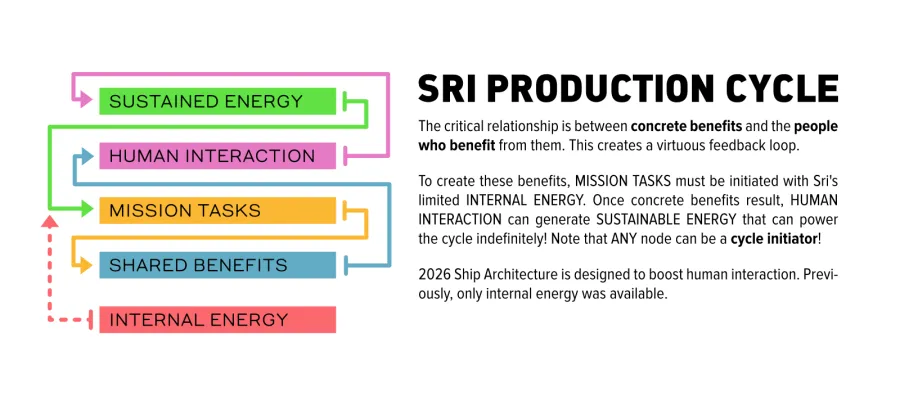
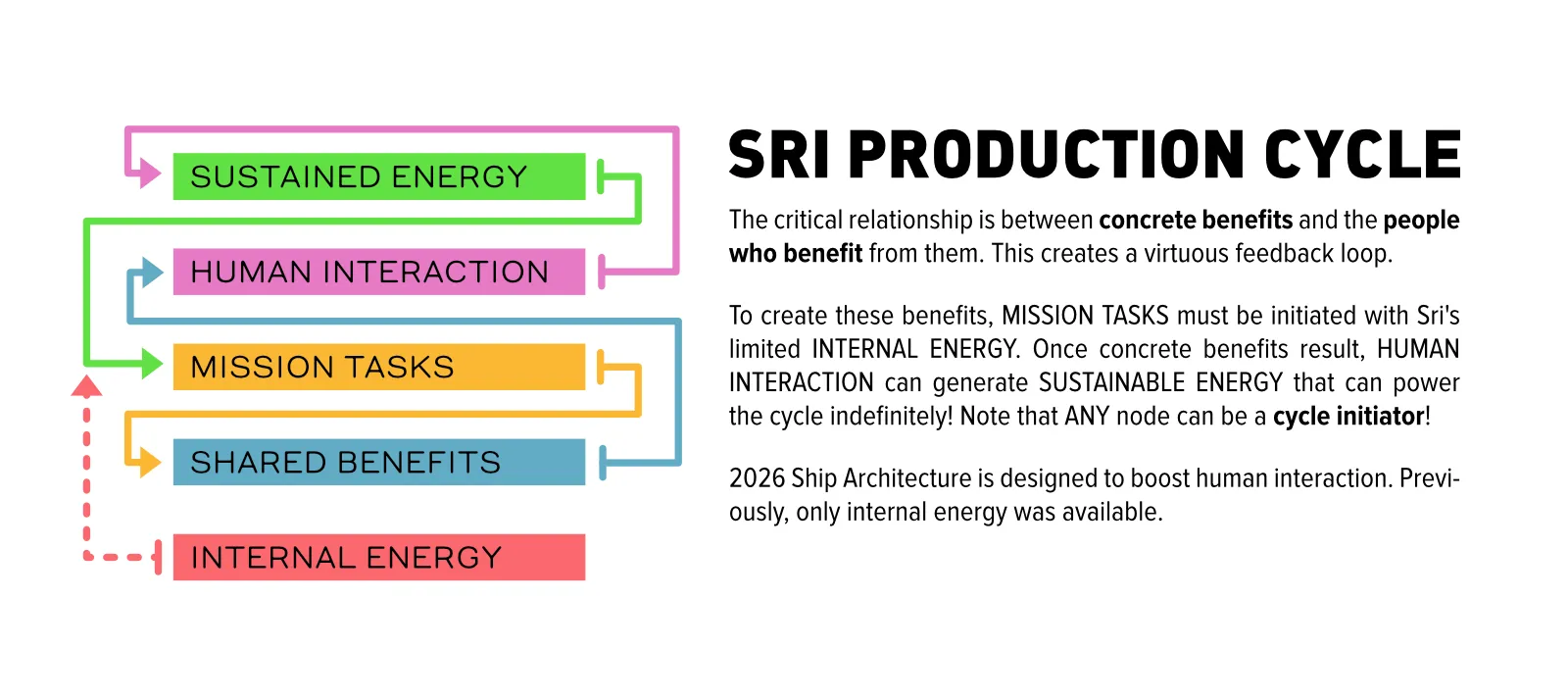
The key module is human interaction, though really any of the modules can serve as an initiator, including my own tiny reserve of willpower (labeled as “Internal Energy”). Previously, I had relied only on Internal Energy to try to do everything by myself. This is a key failure mode that I have encountered over and over again. I called this The Execution Gap in the April 4 Report, noting also that it was isolation that made the gap feel so wide. It was in that report that The Ship was born as a way to bridge the gap.
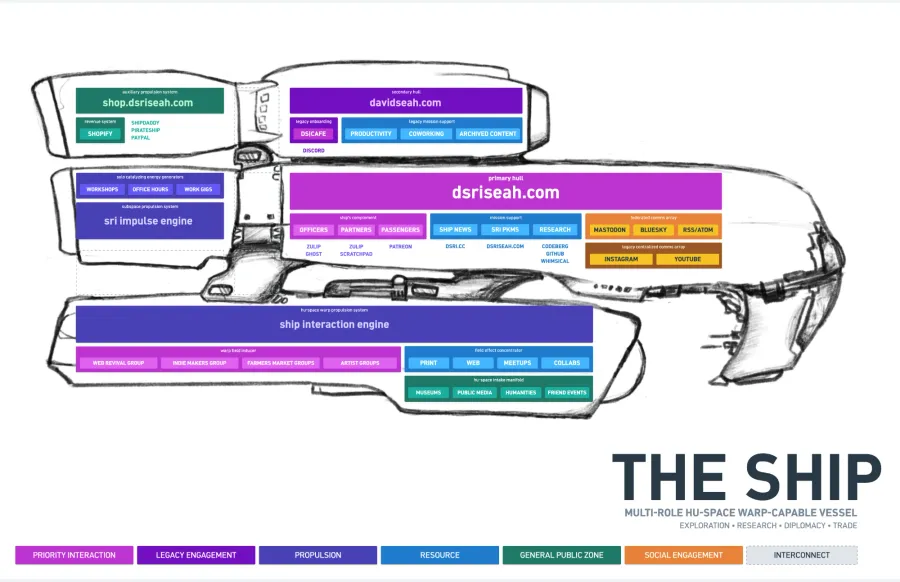
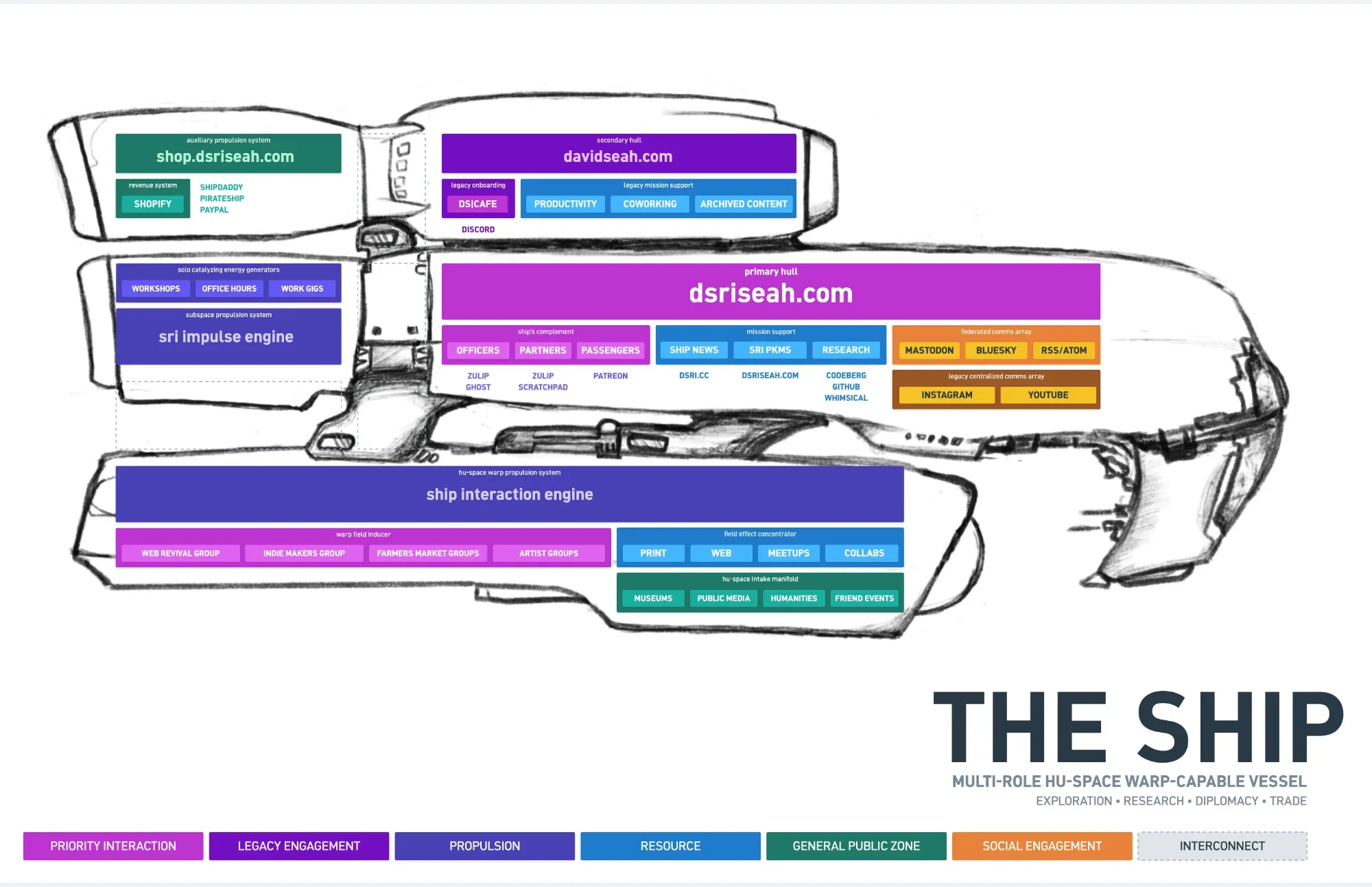
The Ship is a significant upgrade from my prior solo effort. It’s designed to use human interaction as the power source for the Ship’s main propulsion system. Previously, I had relied entirely on my own limited Internal Energy, dog paddling toward goals that seemed to get farther away as I floundered. The wager is that harnessing human interaction will be more effective than that.
Another important aspect of the Ship is that it’s a vessel designed to embody and operationalize ideas like All the Animals to Be Friends for others also looking for a collaborative win. Opening myself up to that is a big step for shy little me, so my trust tool LOGIC outlined a comprehensive operational doctrine in the May 5 Report. It’s firmly founded in my own values and desire be around other nice people“positive-minded, self-empowered, curious, conscientious, competent, generous, and kind people who enjoy sharing knowledge and work experiences”, aka The Tribe, is described in more detail here. who want to go on cozy adventures together.
I have a spaceship! I have the theoretical capability to move with greater efficiency. Looks great on paper. All I need to do is start…
And I’m not really sure how to do that.
For the first time I’m trying to include other people and I’m not sure people are even interested. I have significant anxiety about that because despite all the stuff I’ve outlined above, I still think really differently than other people and this tends to come out in the way I talk. Most of my memories of this are of people not understanding me, which weighs on me heavily. It feels like I’m asking to be rejected.
To get unstuck, I’d like to have some kind of guideline that works with my innate cognitive shape, just like this and the previous stratagem. What comes to mind harkens back to my very earliest interests in world building and storytelling.
3. Finding the Story I Want to Tell
I like characters in a good story, so much so that I’m willing to overlook giant plot holes as long as the character acts true to their nature. In other words, the plot is secondary to the character’s through lineThe term was coined by 1800s Russian director Konstantin Stanislavski, who laid the foundation of contemporary acting through his students that moved abroad! “Method Acting” is one branch of his legacy. See the Wikipedia entry on Through Line for more information..
As I understand it, a through line links what a character is doing to the why behind it to have a genuine understanding of what drives them forward. That understanding includes the world, the backstory of the character, the particulars of the plot, the psychology of the character…really, anything that contributes to authentic presentation of that character in a real way.
I have to admit that I have never had a through line for myself. What I’ve done is log what happened while I’m investigating some question related to creative independence. This is not the same as having an articulate point of view; it’s more science than story. But I do have experience writing ad-hoc stories that transform boring tasks something more enjoyable. These sometimes include an alter ego version of me in them, and they do have through lines of their own to motivate their actions. Can I apply the same to me in real life?Another example of this is main character energy as explained by this article on Psychology Today. The idea is also present in the LitRPG genre.
The process I’m talking about, using characters as stand-ins for myself in a metaphorical story structure, is a process I call narrative-driven designNarrative-driven design is my term for “making difficult solo work more interesting by writing about about myself in the third person as if I were doing something much more exciting”. I have notes in this entry., and I have a fair amount of experience doing it on-the-fly. It flows naturally.
So…
Can I use narrative-driven design to develop a new through line for my story?
To answer that question, I first established two points of view: Sri as Character and Sri as Director. At the highest level, this is the work that I want the story to do:
Tell a story about a neurodivergent character that all readers can relate to.
By rooting for the character, readers will see ways they can also root for themselves.
Emphasize the humane aspects of the story over technique and methodology. Those are pushed into the background where they belong.
I then created more detailed guidelines to help me understand the through line from multiple perspectives: Sri the Character (who is living through this life) and Sri the Writer/Director (who has a message of their own to deliver to readers). The message is a remix of things I have believed for a long time but never knew how to express in an interesting and authentic way. This is a seventh inversion related to marketing of ideas:
- Instead of writing in direct appeal to the needs of an audience, I want to write to draw people into my world and make them feel at home. The effect should be similar without being manipulative.
I’ve prepared an abbreviated version of my writing guidelinesThe full breakdown is collected in the appendix Sri’s Writing Doctrine. Fair warning: this gets DEEP into the weeds. It might be of interest to other serial narrative designers or bloggers developing their writing voice. below that outlines the perspective of Sri the Character and Sri the Director.
As Character Sri
- The through line: “Isolation is killing her slowly despite adapting to the world. Will she realize this and figure out what to do about it?”
- The Wager: “Will Sri see the pattern in time? Will she be brave enough to leave the comfort of her nest? Will her determination see her through in the face of past failures?”
As Storyteller Sri
- My Directorial Rule - Show Sri’s truth as truthfully as Sri is truthfulHere “truth” is derived from values of authenticity, transparency, and curiosity; it is “truth to myself.” See Values-first Productivity., emphasizing patterns related to Sri’s through line, wager, and backstory.
- My storytelling objective - Show Sri not as heroine, but as someone facing isolation. This is a relatable universal human pain that Sri is depicted facing in her own way, a curious example for us to follow.
- My long term storytelling objective - Ultimately, the goal is to help audiences root for themselves as they root for Character Sri.
- Keeping audience interest - Sri’s asymmetric approach to life is interesting because it’s different. The details are pushed into the margins so the story remains clear.This is my adaptation of the maxim Show Don’t Tell. My past writing is largely expositional reporting, which can make for tedious reading..
And with that, I have a cheat sheet for how to write about myself in the future. This is the security blanket I need to ground myself this new role. The hope is that through narrative-driven design, I’m creating a playful style that is grounded in truth. The writing doctrine defines both my character through line and my writer’s objective so I don’t lose sight of what I’m trying to do.
It’s exciting and a little weird. I don’t know if it will work, but that is the adventure that I am looking for. If I can tell the story well, maybe I’ll reach the people who will want to join me. Another experimental gambit, but one that might be fun. And isn’t fun sort of the point of it all? Creative independence was created not just to have freedom and financial stability, after all…
The point of creative independence is to have enough security so you can afford to have good times with your friends!
You know, I have a tendency to forget that point. Insight filed under “Duh.”
Next Steps
These three stratagems are all designed to address one thing: bridging the execution gap that has caused my efforts to sputter every year. That’s the big bad of my story, my antagonist. In the days to come, I’ll be testing whether this reframing exercise is effective or not. That’s a post for another day.
Another from this massive reframe is that all previous years of Groundhog Day Resolutions are mere backstory now! I’m starting a new story with a new attitude and a new writing voice. I’m no longer expecting to neatly wrap the past 20 years of personal investigation with a tidy bow. This makes me feel much lighter. As I’m starting anew, I’m using this phrase as a starting prompt:
This is a story about what could be.
It’s hopeful yet non-commital, but that doesn’t free me from my responsibility as a writer to show that “what could be” is worth having, worth wanting, worth rooting for anywhere you see it. That is the message. The story carries it, and the background marginalia documents the methods for those who want them.
Because this Groundhog Day Report took so long to write, I am taking July offFun fact: This has been totally allowed in the official Groundhog Day Resolutions rules since 2007! so I can slowly get everything ship-shape and start exercising all these new systems. It’s going to be fun and new, I think. I just don’t know exactly what’s going to happen, but that’s asymmetric warfare for ya. We adapt, and do our best with what we know, moving forward when the opportunity presents itself.
So say we all!
INDEX of GHDR 2026 POSTS
Kickoff Pt 1: A brief overview of the “four acts” of 2025
Kickoff Pt 2: Identifying the big questions to explore in 2026
Kickoff Pt 3: The Plan
Blunting Fear and Anxiety
Shrinking The Execution Gap
Reframing Chores as Ship Operations
Setting Sail!
A New Story from Inverted Assumptions
Resting Before Acting
Ship-Shop Flip-Flop
Small Stories for Small Steps
Into the Doldrums
Nov 11
…
Dec 12
…
GHDR 0606 Appendix: Sri's Writing Doctrine
GHDR Report 0707: Resting Before Acting
Chat about tools and aspirational projects on my DS|CAFE Discord server. Chat me up on Mastodon and Bluesky