This is an appendix for the main Groundhog Day Resolutions Report for June 6, 2026. It describes the production process for making the Ship Operational Diagram from conception to print.
First things first: How does The Ship even move?
As I established in the May 5 Report, the way my business activities work as a “ship” requires some kind of medium to move through. How does a business packaged into a ship metaphor make any kind of sense? This is what I had come up with:
The Ship “moves” through human interaction, encounter by encounter, over a period of time.
The Ship is also not an entirely new vessel. It is comprised of older systems like my old website and the productivity tools hosted there. It also includes old design and software development work that has still has utility.
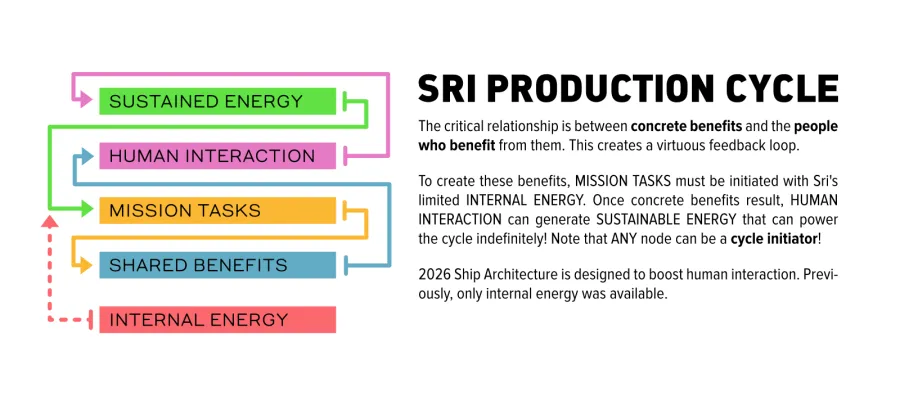
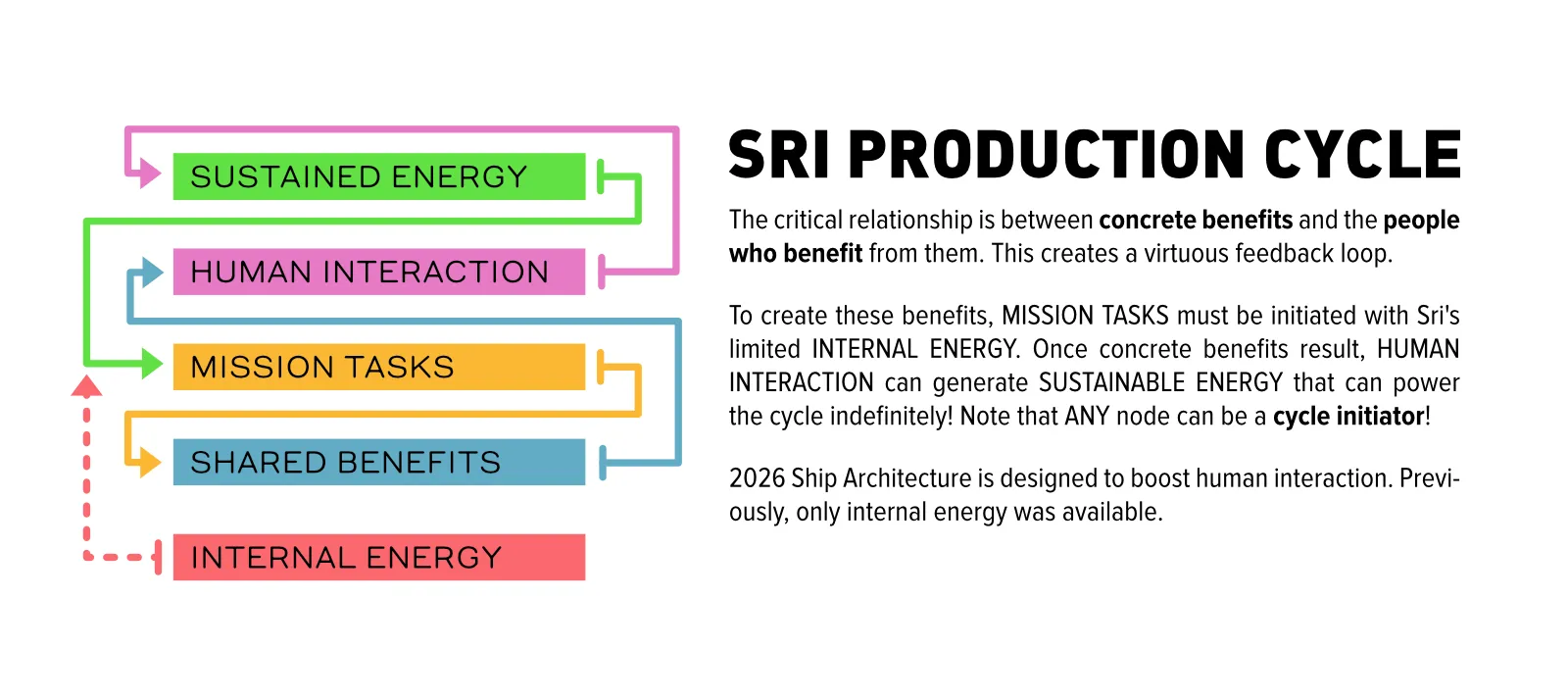
What’s new is the warp propulsion system that uses human interaction as an energy source.
Previously, I only had myself to use as an energy source. Solving the energy problem has been an ongoing theme in ALL of my Groundhog Day Resolution campaigns!
Ideation of The Ship’s Operational Systems
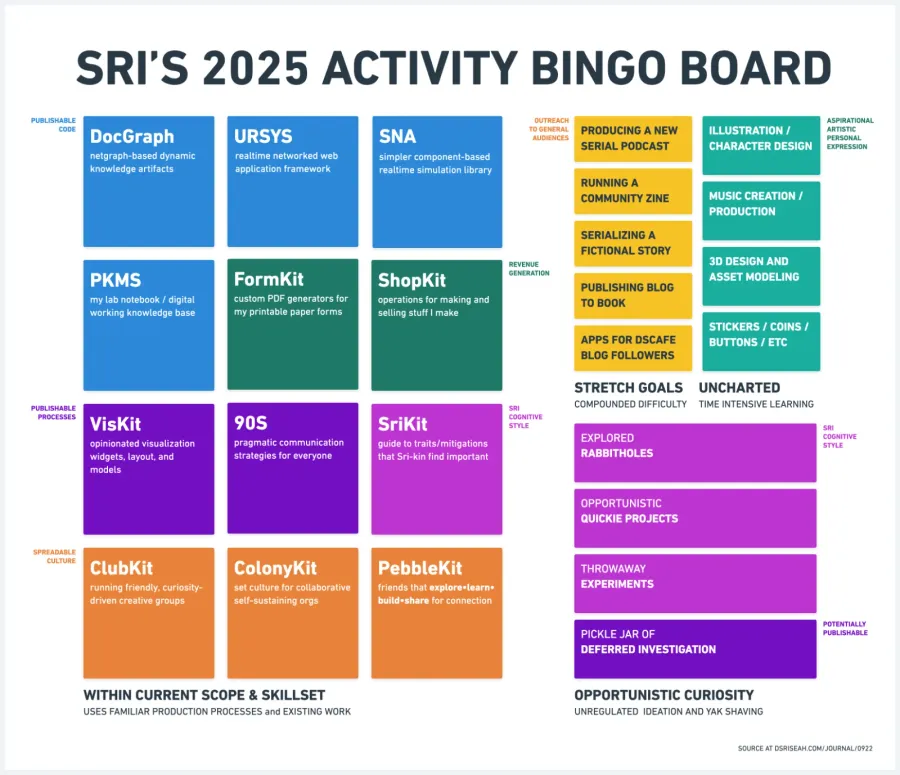
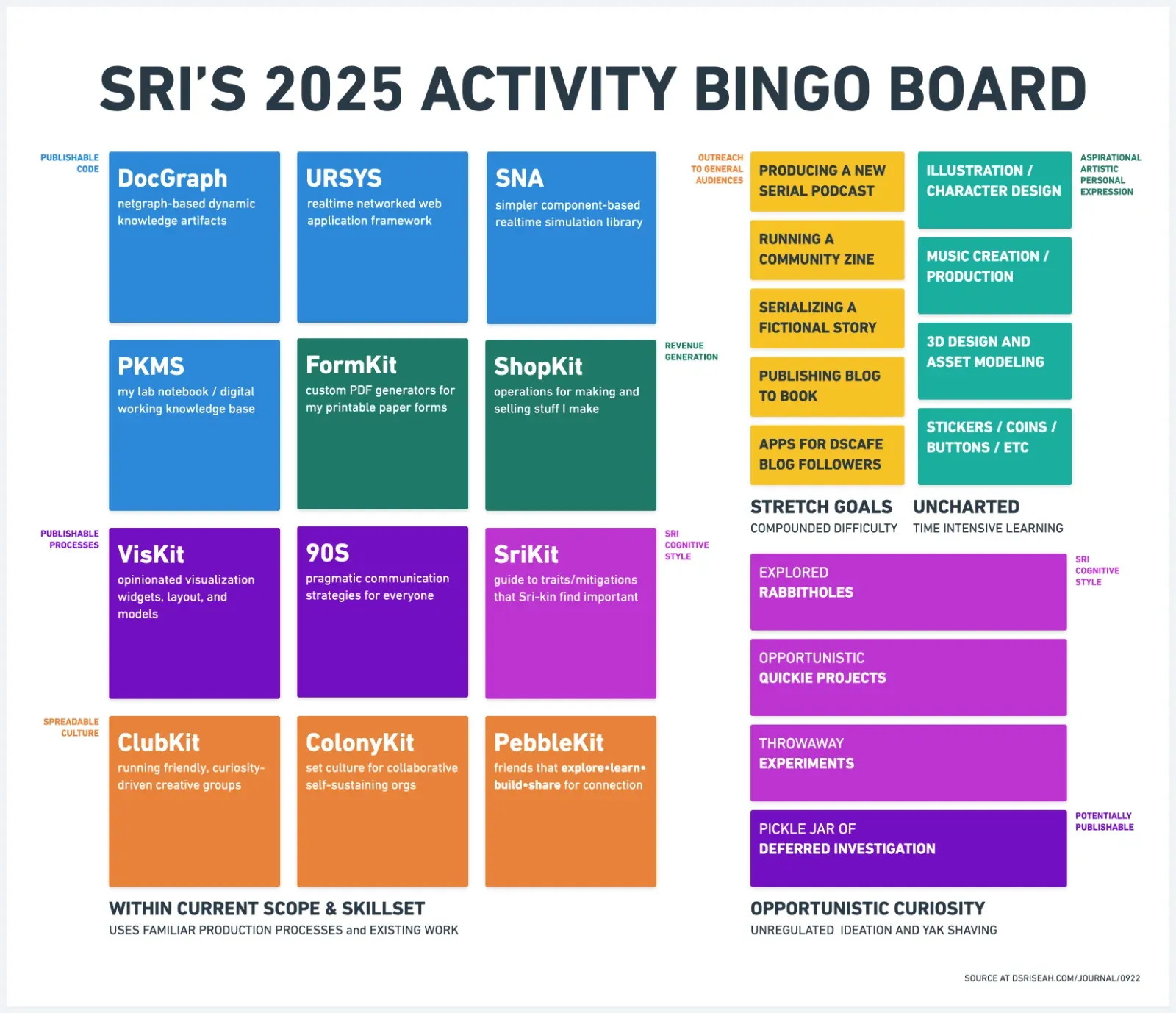
I like to have a compact visual reference available to stare at during GHDR so I can remember how everything is supposed to fit together. An example of this is last year’s Activitity Bingo Board:
To start the process for the Ship Operational Diagram, I printed out snippets of past writing and grouped them by hand into patterns. Once I thought I saw the patterns, I used glue to fix them onto a backing piece of paper that was thin enough to run through my portable EPSON DS-30 scanner without jamming.
PAGE 1: “The Old Testament”
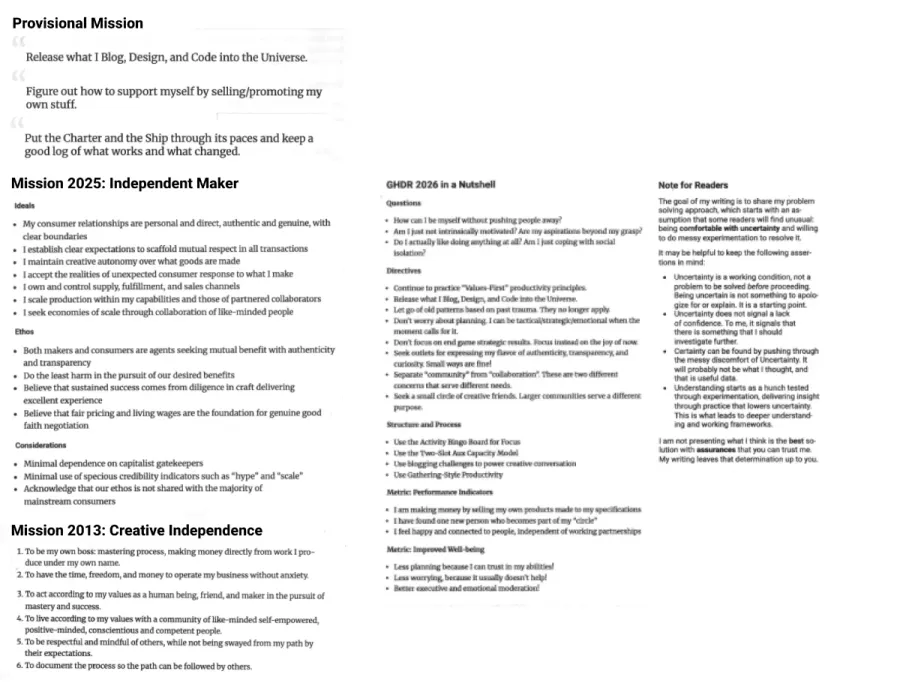
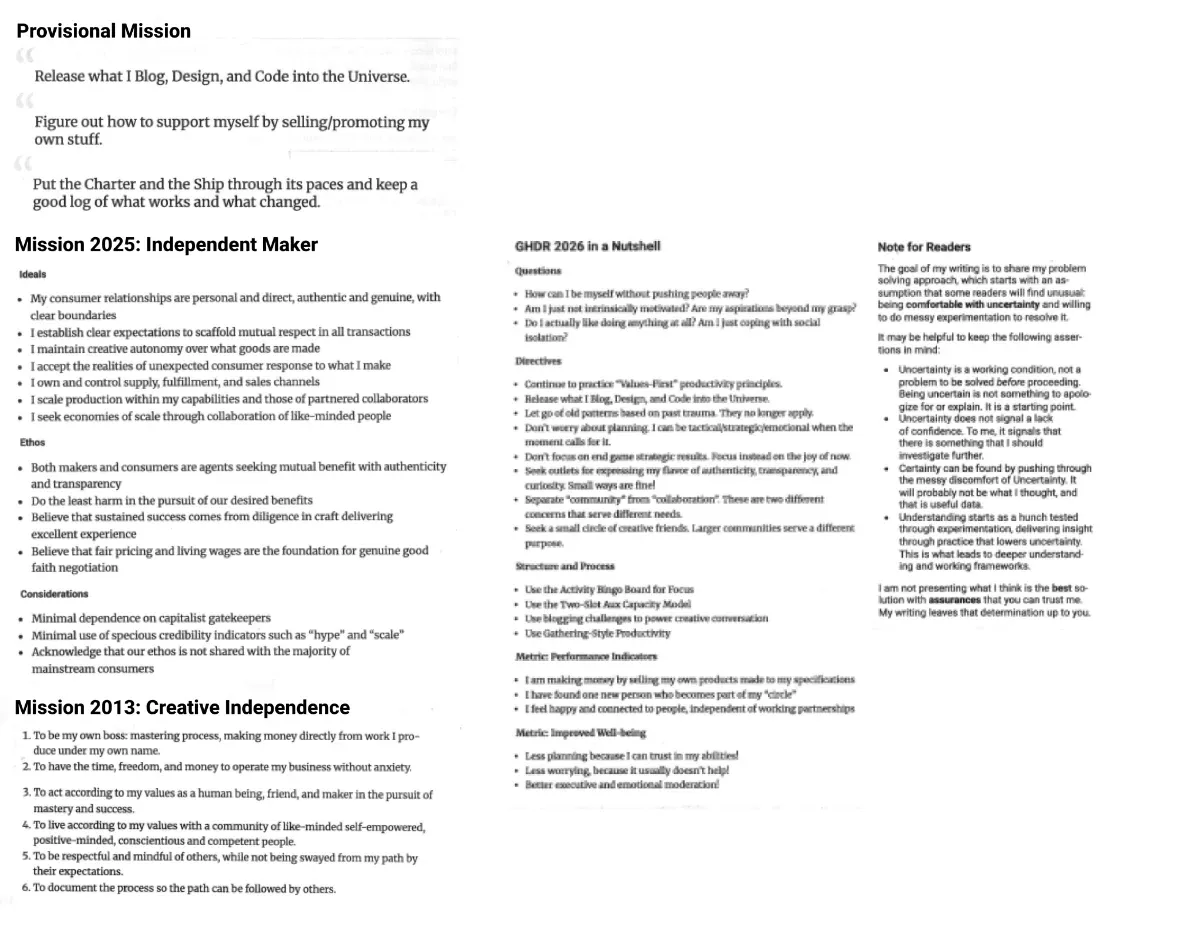
PAGE 2: “The New Testament”
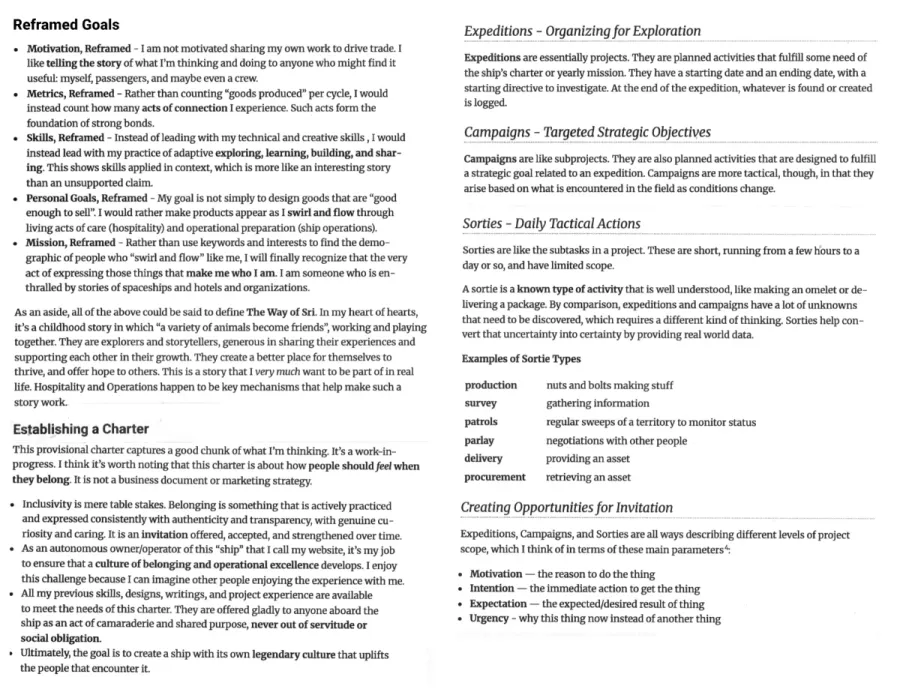
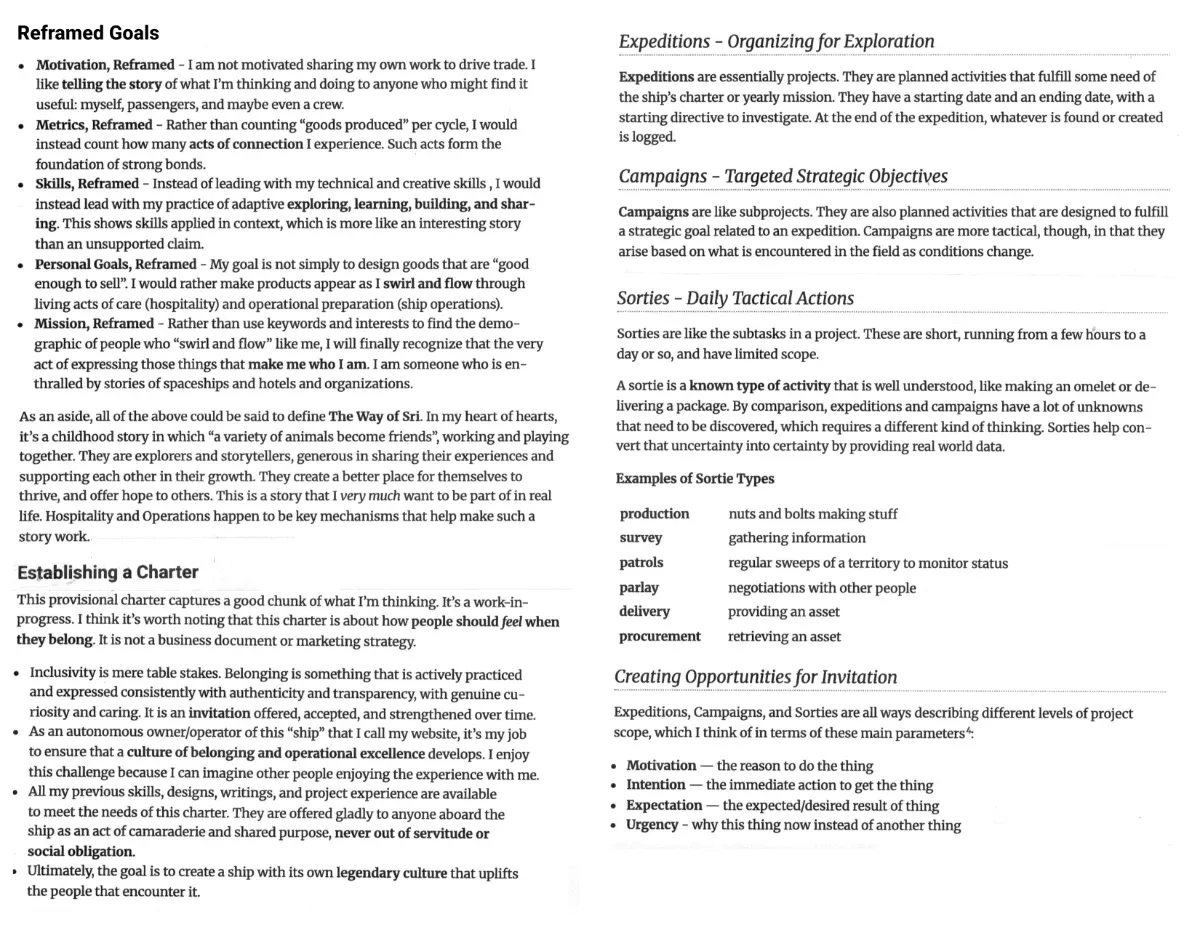
I dividing the snippets into “Old Testament” and “New Testament” pages. This was enough to start doing a systems analysis to identify entities and operations that were implied by the source text. I used GoodNotes 5 on my old iPad Pro to swish the ideas around visually. Then I printed it out and stared at it, eventually adding some important notes about what seemed to be missing:
- “Where is the romance of the journey?”
- “What is the nature of belonging and being?”
- “Where is the cat’s journey?”?
- “Where does the wind blow from?”
- “What sets the direction?”
- “URGENT! An exciting, stimulating flow of happy people doing cool things!”
These are important because they describe the heart behind the reason for having a Ship in the first place. That’s a critical piece of design advice when building anything intended to move people. It works just as well for hearts as it does for physical space.
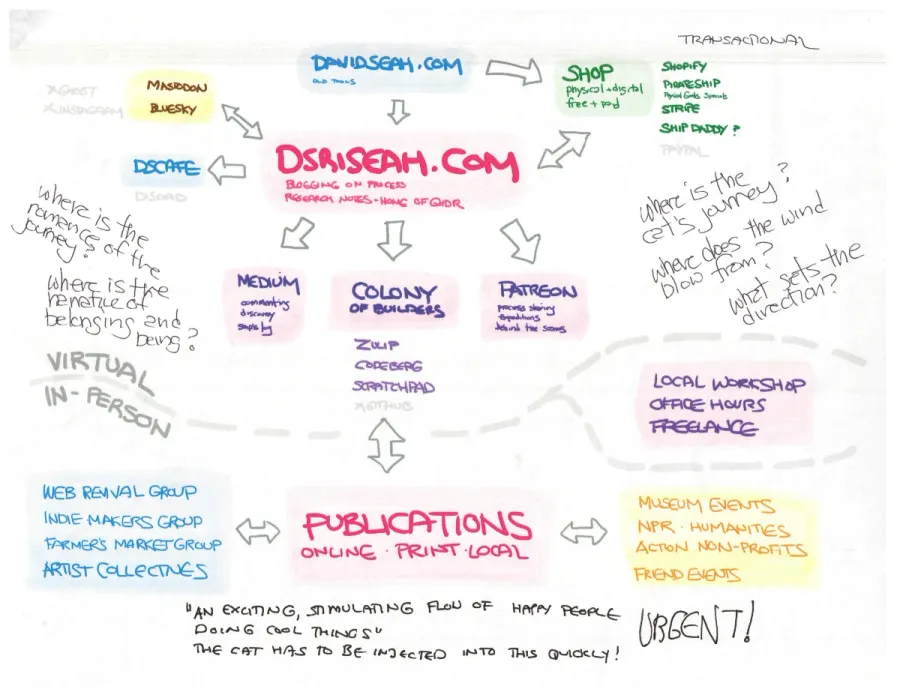
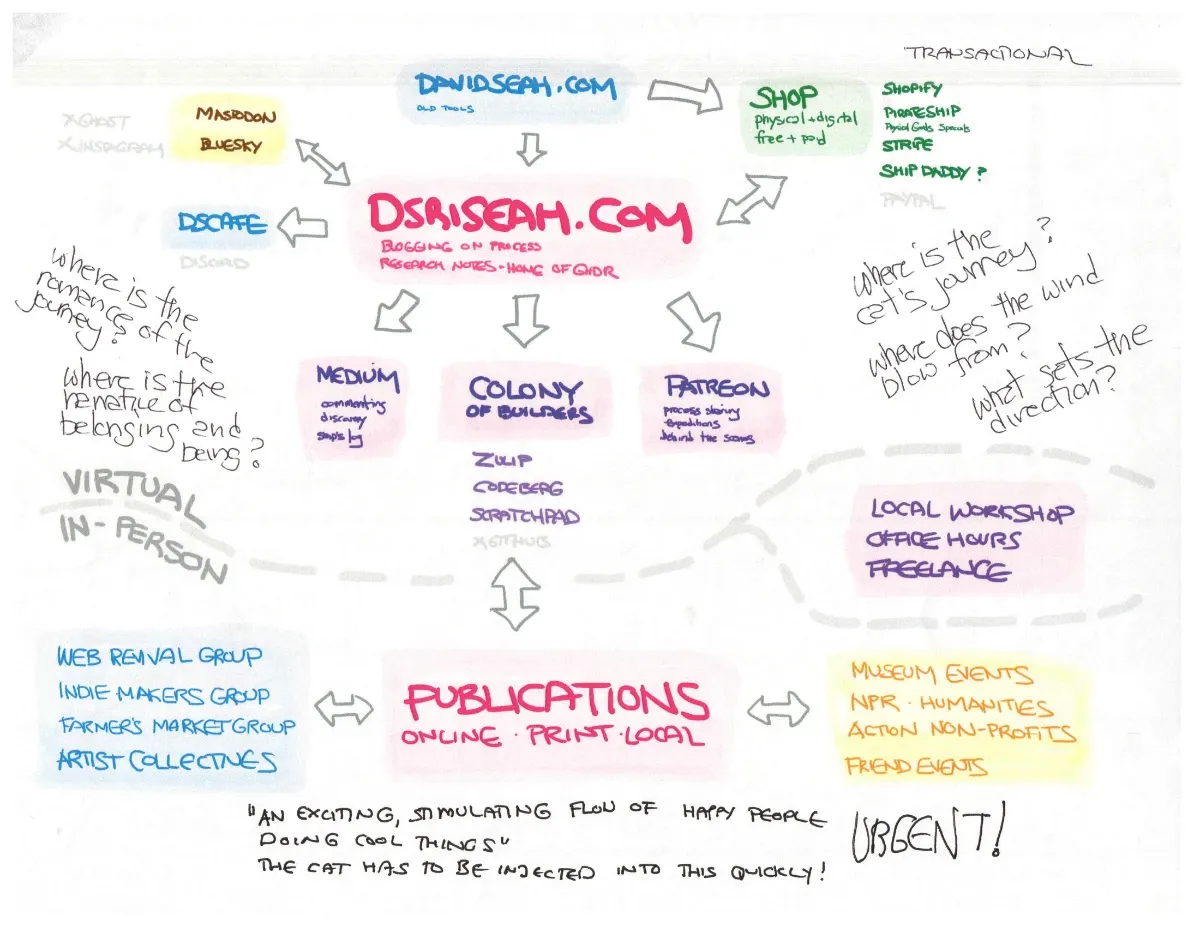
Important insights fell out of this diagram:
- I wanted to emphasize my current live website dsriseah.com as the hub.
- I have existing website presences that capture attention and provide interaction points for different groups.
- All these existing website properties are virtual, which hasn’t proven to be a sustaining source of energy.
- The proposed in-person systems are what HOPEFULLY create a sustainable source of human interaction
At this point, I needed to move to digital so I could start drawing a tighter diagram.
Iterating on the Ship Operations Diagram
Up to this point, I had been making working diagrams that would let me discover, isolate, and refine fuzzy ideas into core concepts. I use the online charting app Whimsical for this work, as it’s unusually well designed to give you aesthetic results without burying you in options like *cough* Canva.
FIRST PASS: SHIP ON THE WATER
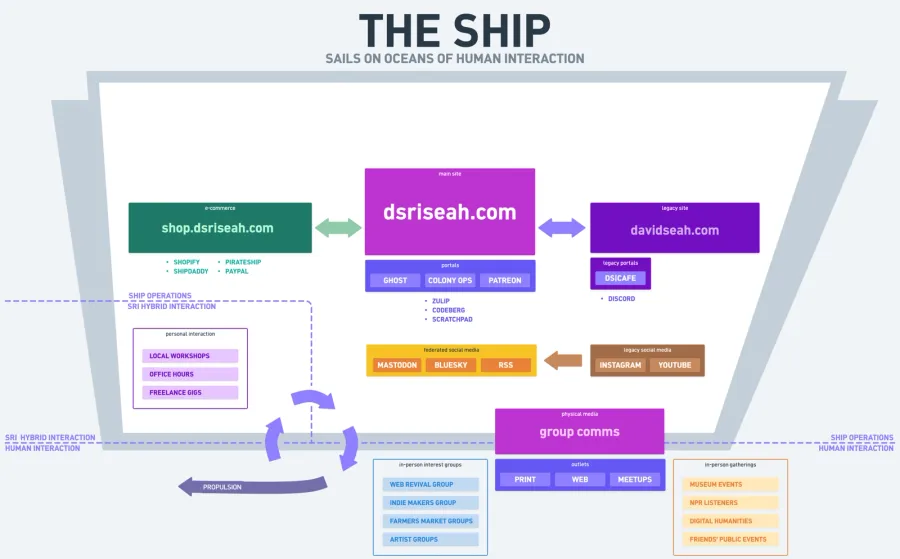
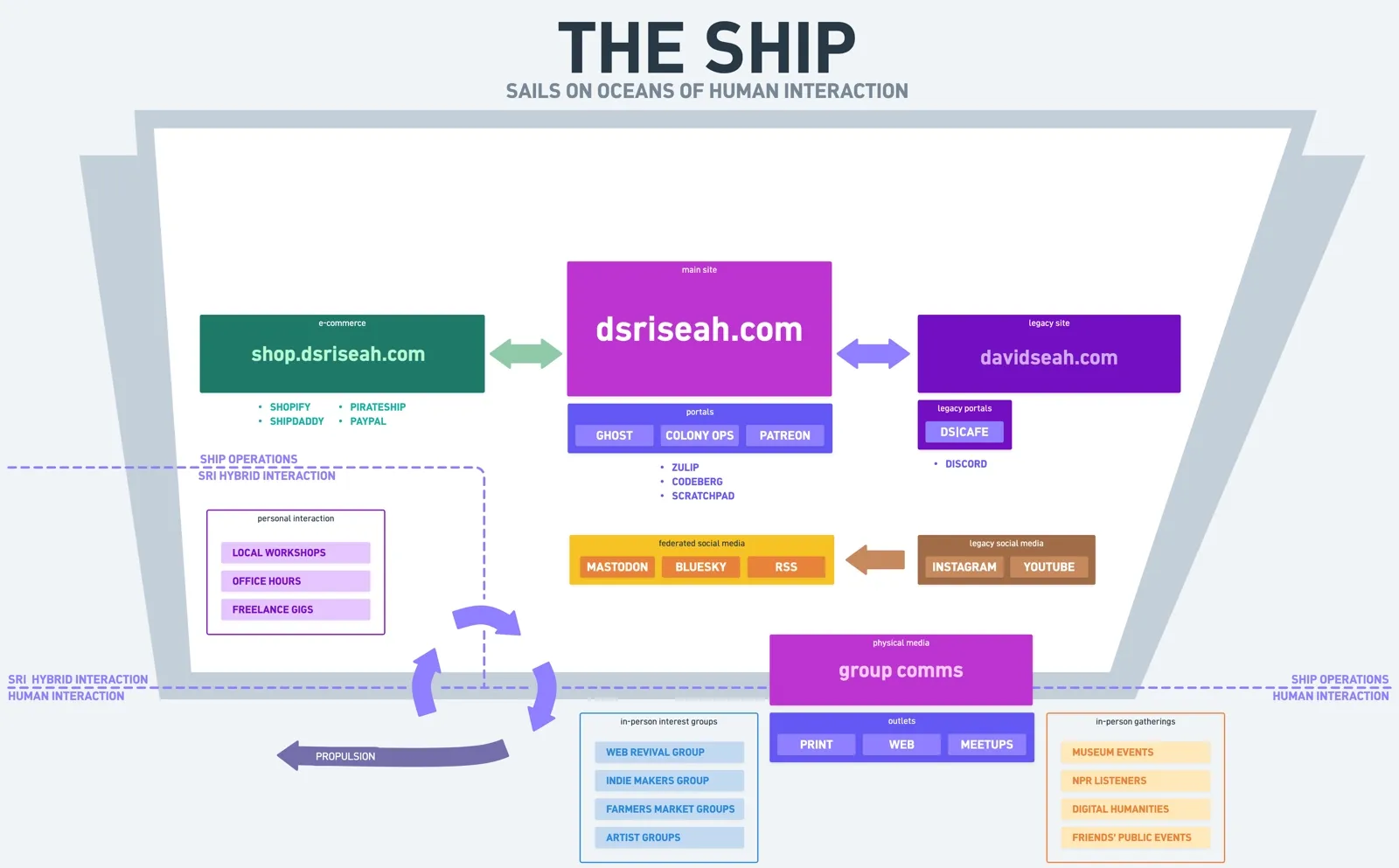
This diagram has all the elements from the GoodNotes sketch in a one-page form. Technically it meets my needs. However, it has visual terrible flow and that makes it unsuitable for hanging on my wall. I don’t feel good looking at it.
One good idea that from this was the idea of propulsion generation, at the bottom left with the swirling arrows moving between the boundaries between internal, in-person, and hybrid systems. The idea that stuff happens when there is interaction between these systems is important; it tells me that I can’t stay isolated in any of these sections and expect anything to happen. The Ship moves only when there is human interaction, and harnessing this energy productivity is a cross-systems integration challenge.
If the metaphor doesn’t fit, pick another metaphor. The ocean isn’t the only medium that ships can move through.
SECOND PASS: SHIP IN SPACE
I had a good feeling that I could restructure the blocks in such a way that they created chunky modules that would lend themselves to spaceship design. As a kid, I used to design spaceships on graph paperFor examples, visit my Spaceship Visual Archive on Flickr! when I was a kid, so I was confident I could make something.
In this case, form will follow function. So I made a revised system diagram. Here’s the final version:
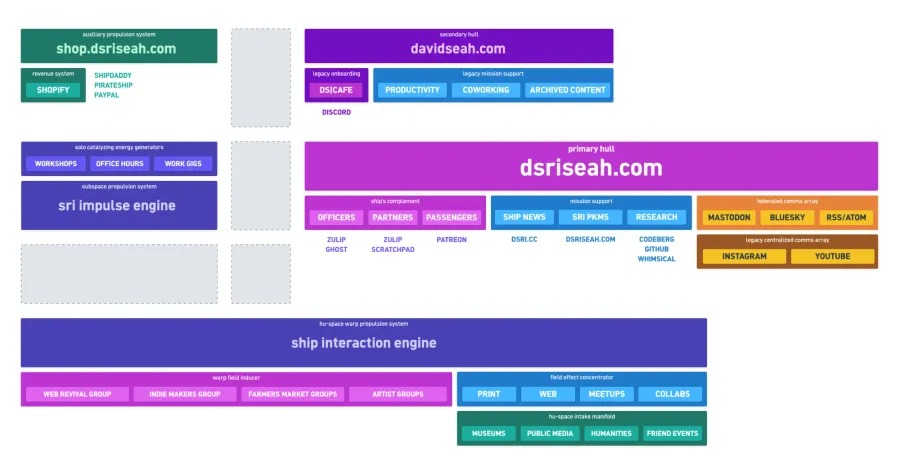
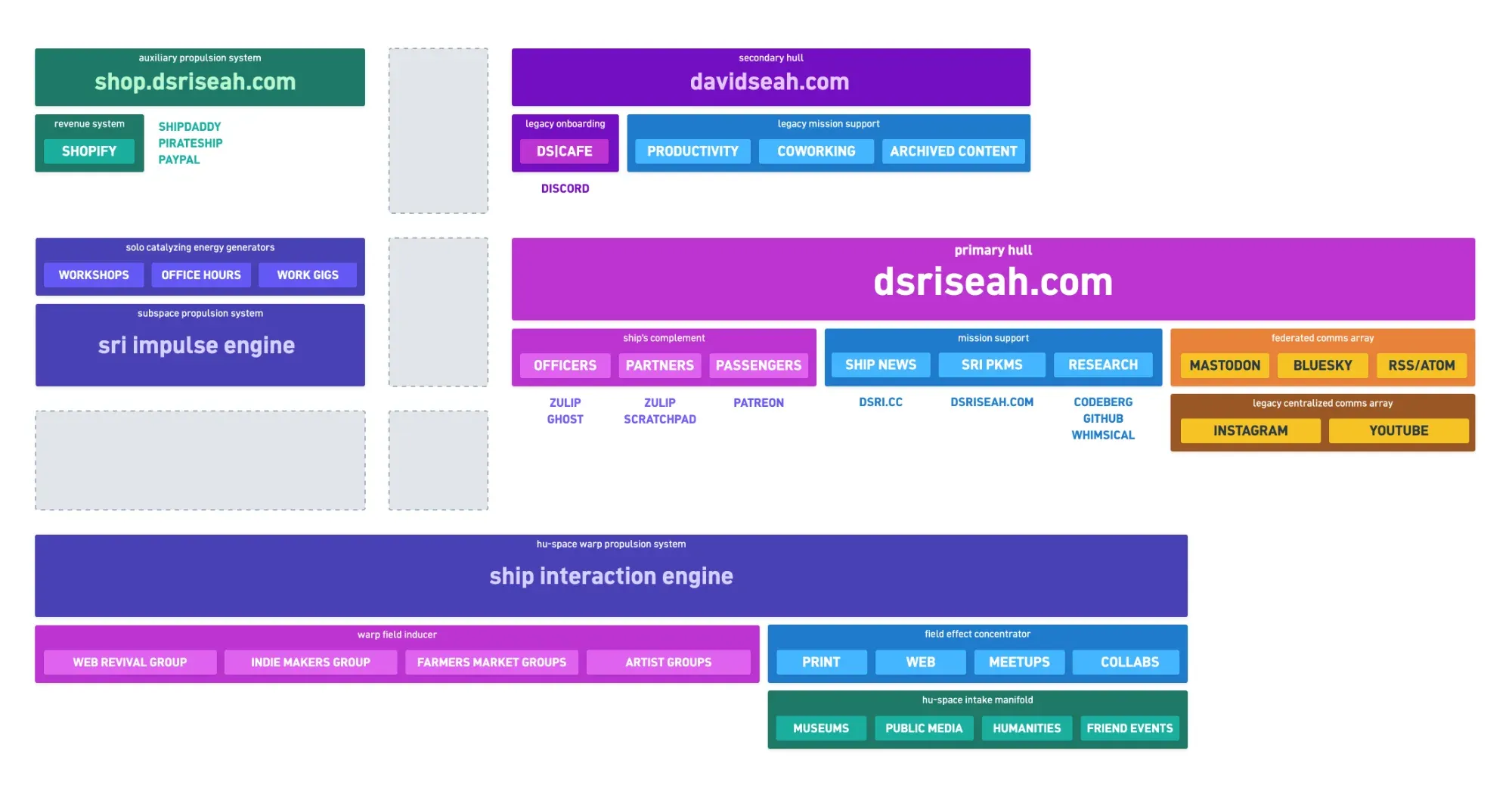
In this version, human interaction is now framed as a warp field that is generated by things I put into the public, and propulsion results as this field interacts with human to move things forward. The “hybrid” section is now the impulse engine that draws only on my energy to generate propulsion. It’s the “old testament way” I moved before. The ship interaction engine is the modern propulsion system, both generating the conditions for creating human interaction and harnessing them.
The combined propulsion systems of The Ship can be succinctly illustrated with this supplementary diagram:
THIRD PASS: SKINNING THE SHIP
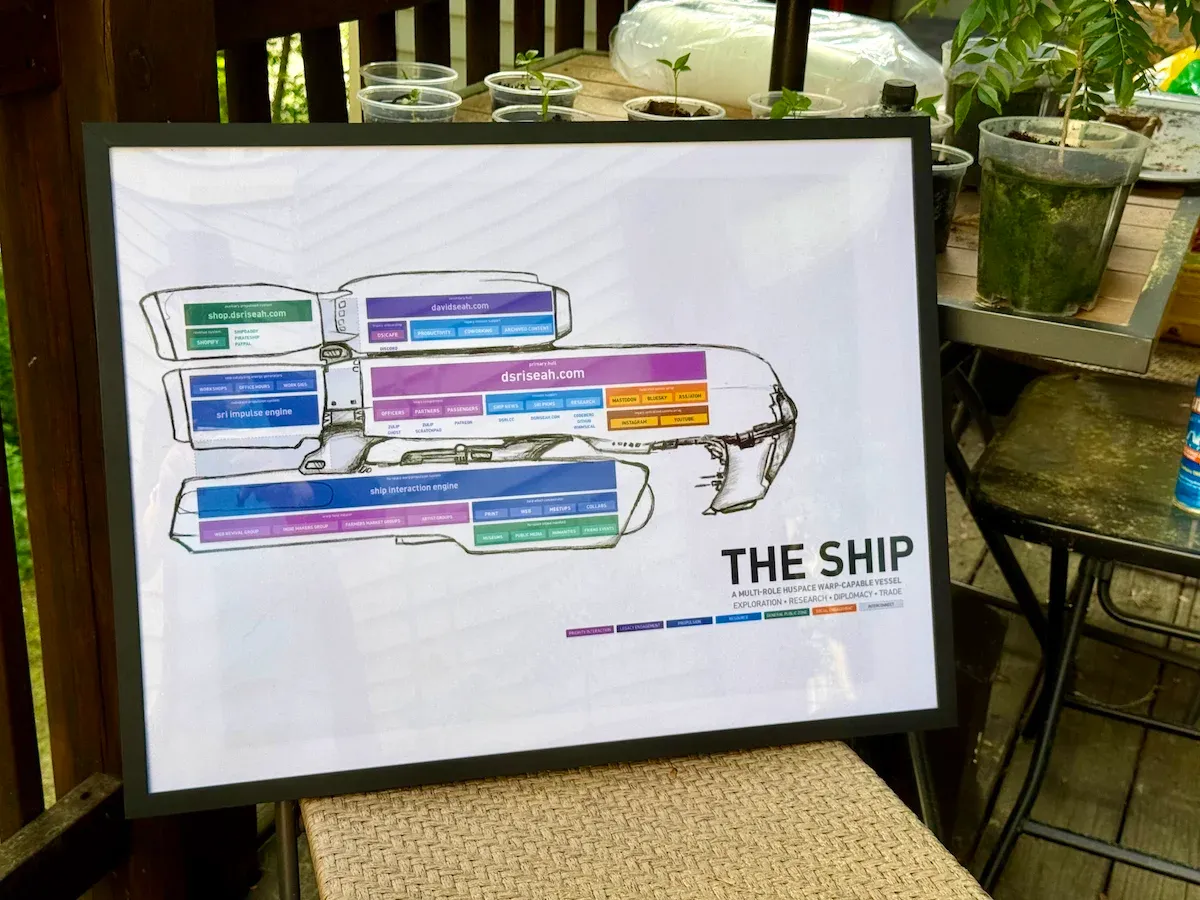
With the modular diagram settled, I could do the fun part: drawing a spaceship. I used ProCreateI was not that familiar with ProCreate, so this was a learning experience that I didn’t really want to budget for. I’m glad I tried it though! on the iPad to draw on with the module diagram as the background layer. I basically just drew an outline around the modules that looked sort of like a space ship and hoped for the best.
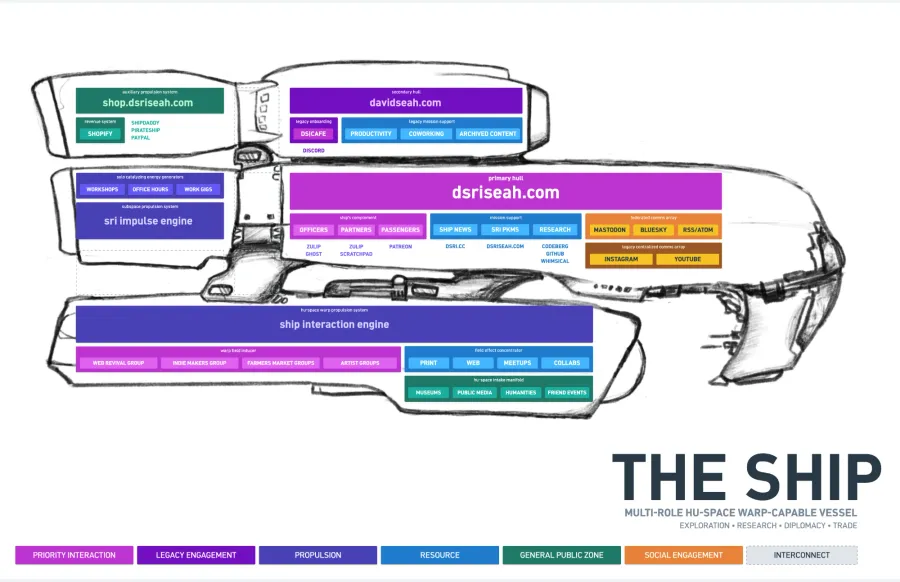
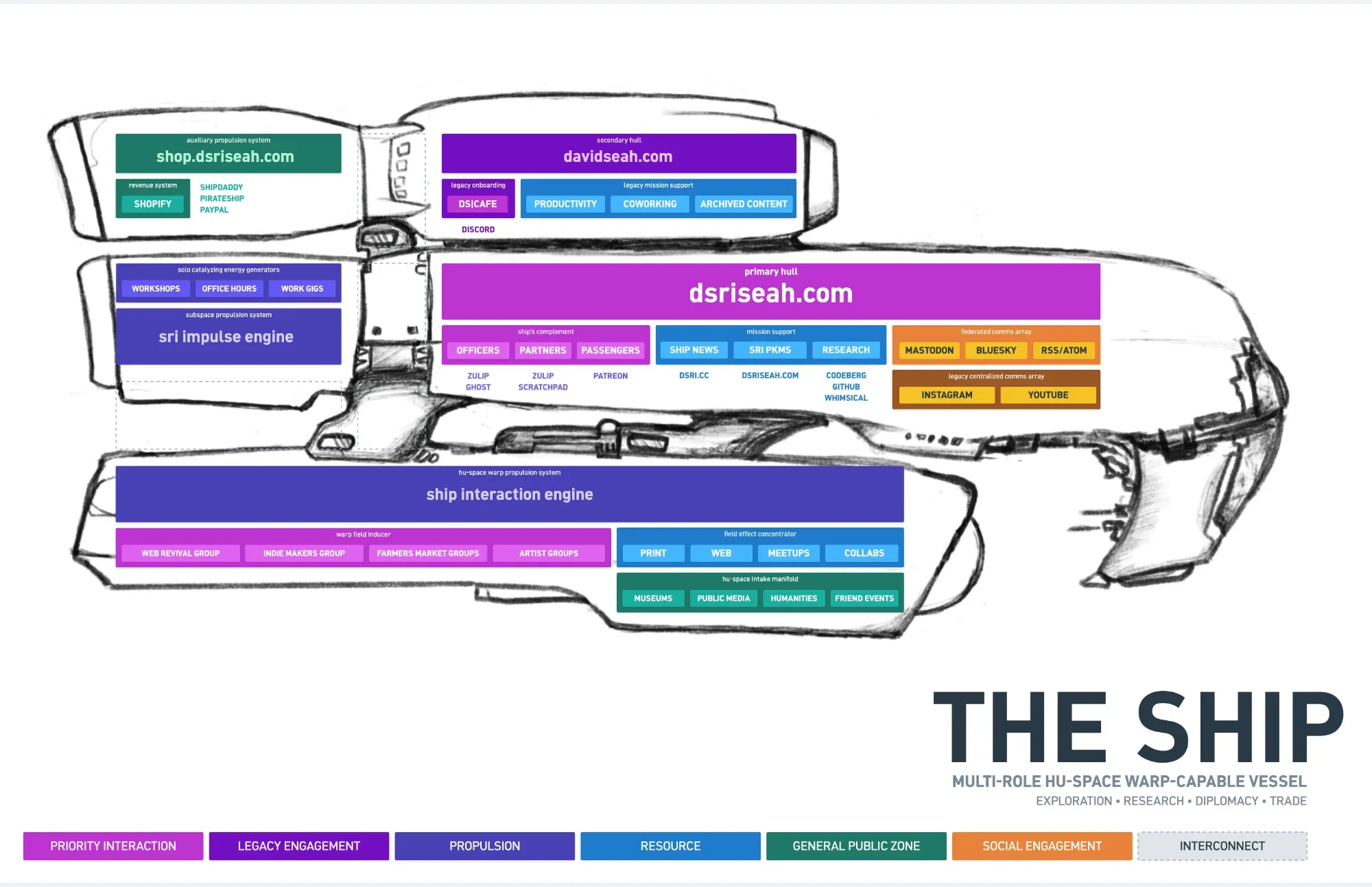
It’s not the greatest drawing I’ve ever done. The detail doesn’t imply any real function or mechanical structure. But you know what? it looks like a spaceship and that’s enough to get the job done.
I think this diagram is much more successful because it feels structural, and there is enough visual hints on what connects to what to imply the swirling between different systems to make the thing work. It should work well as a visual reference moving forward!
Linking Old Systems to the Ship
Earlier I mentioned the Activity Bingo Board as the previous visual guidelines from 2025. They were focused on what I could be doing to generate goods that would trigger interest, listing all the things that fit my interests and capabilities. All of this is still true, and those old systems need a place in the Ship.
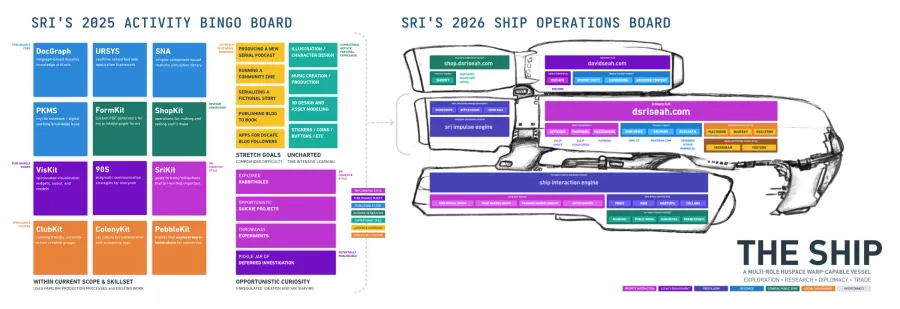
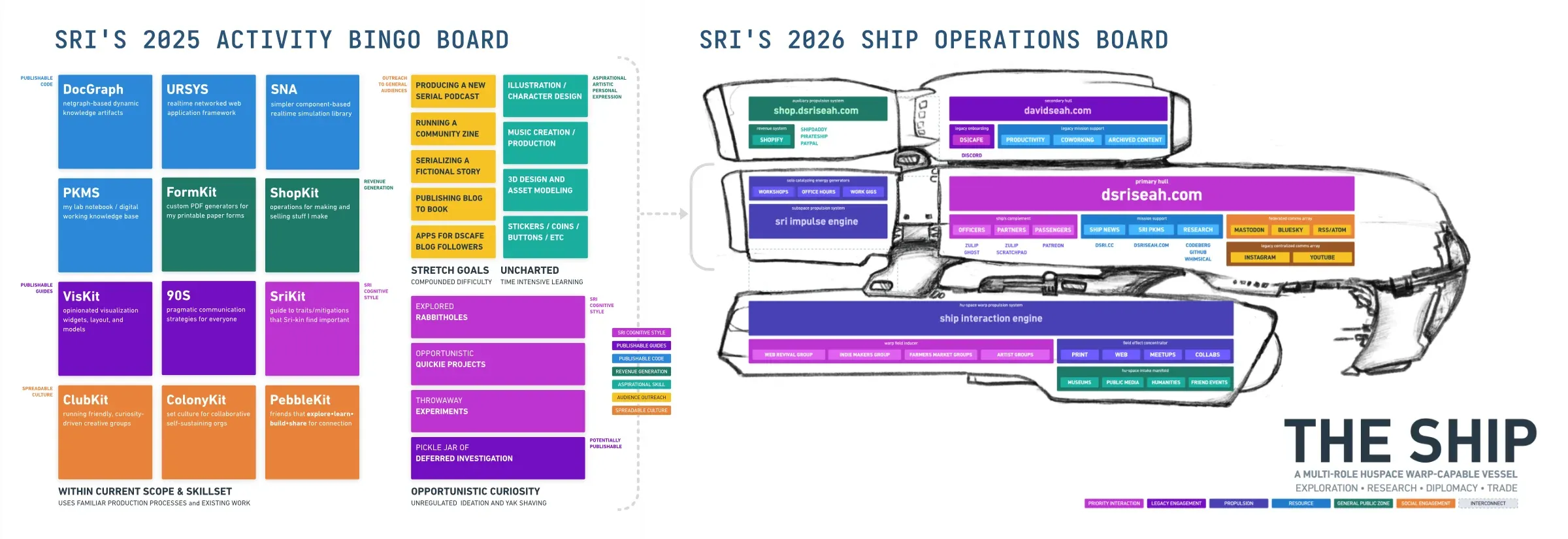
This depicts how the Activity Bingo Board is a subsystem of the impulse drive. This is the propulsion system that relies only on my INTERNAL ENERGY and is in short supply. Here’s an expanded version of the above diagram so the connection is a bit clearer:
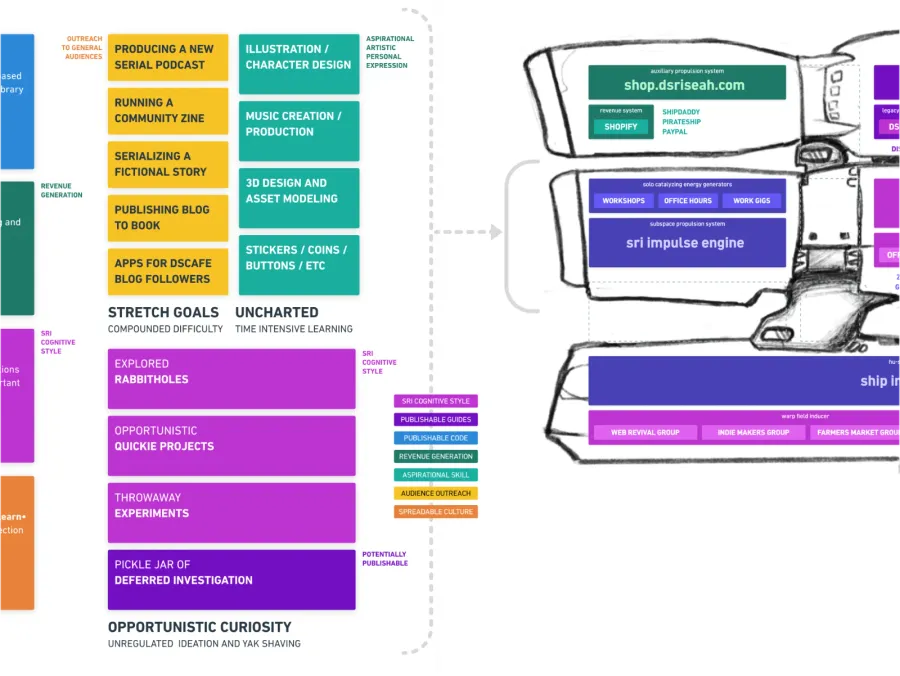
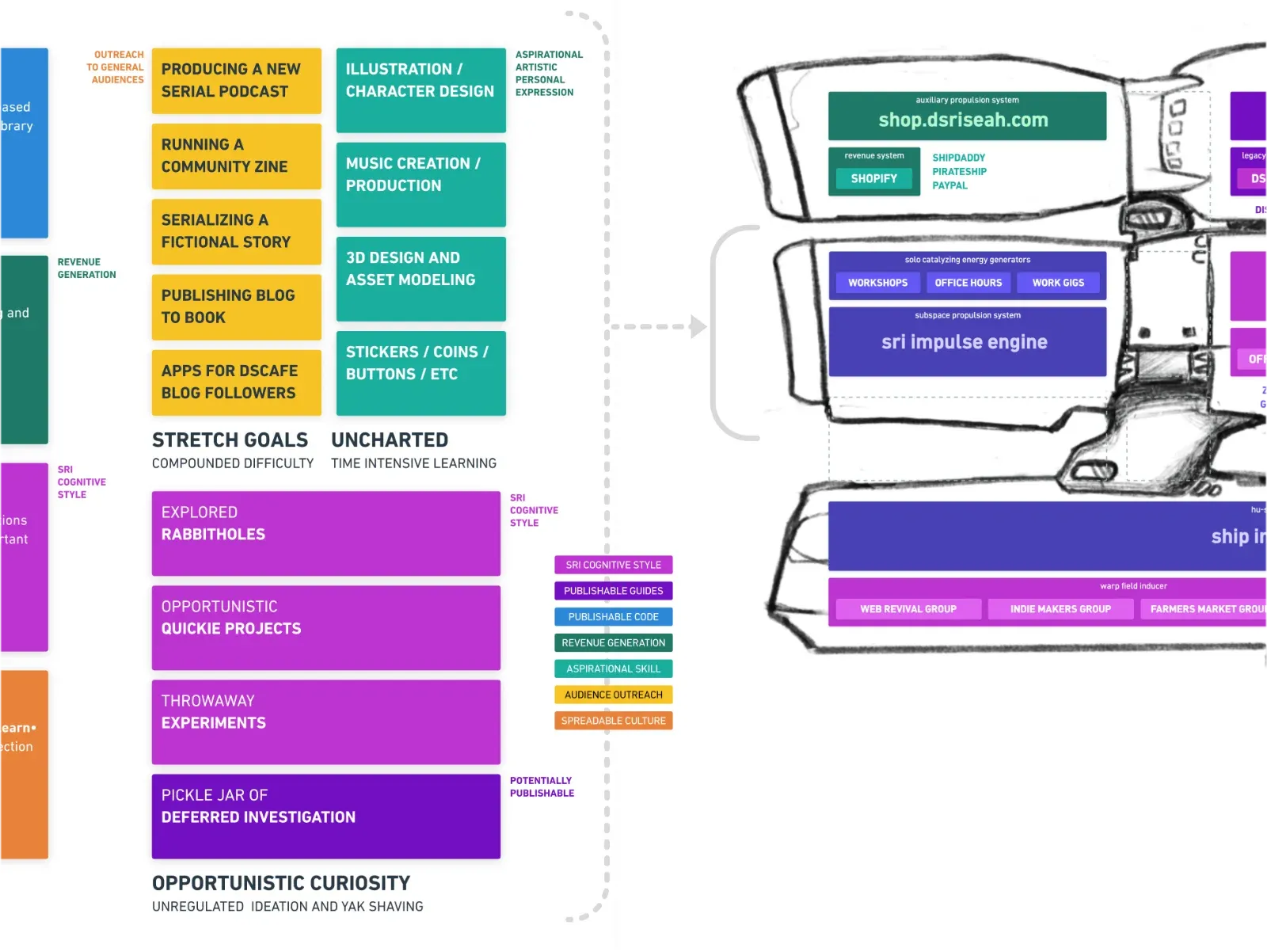
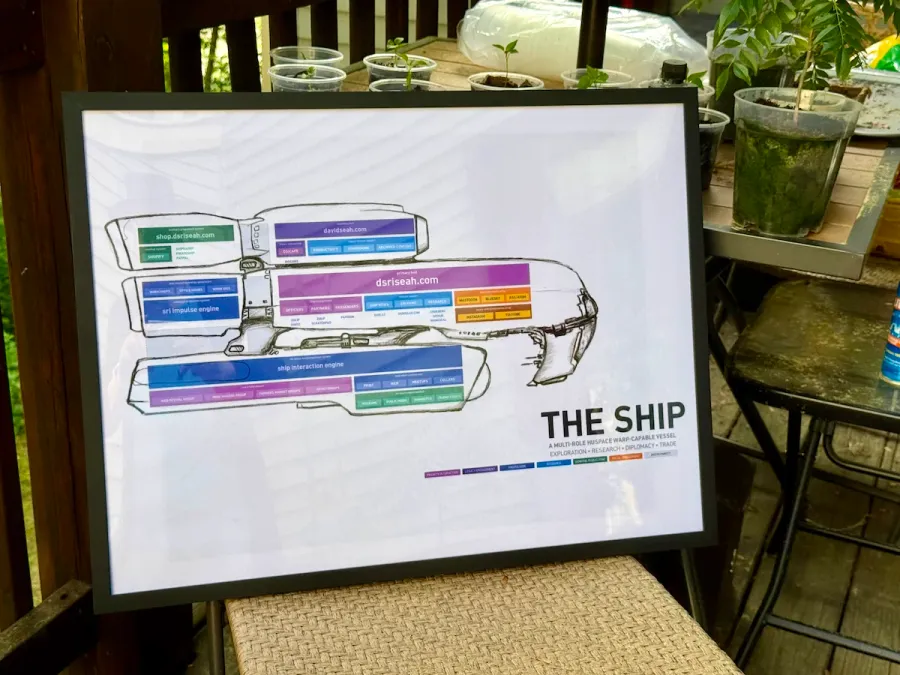
I had engineering prints made, bought a cheap frame online, and am now looking for a place to hang this up.
« Back to GHDR Report 0606
GHDR 0606 Appendix: Timeline of GHDR Evolution
GHDR 0606 Appendix: Sri's Writing Doctrine
Chat about tools and aspirational projects on my DS|CAFE Discord server. Chat me up on Mastodon and Bluesky