Part 3 of my Groundhog Day Resolutions Kickoff series sets the questions, directives, metrics, processes, and structures for 2026. Largely picking up where I left off last year! Let’s go!
Groundhog Day Resolution Dates
Here’s the suggested schedule for starting Groundhog Day Resolutions. Note that you can technically start on any double-day, not just February 2nd! The important thing is that you review monthly.
02/02 Feb 2
Groundhog Day! Lay down the strategic plan!
02/14 Feb 14
Valentine’s Day - Optionally, use this as the start of planning, and finalize your goals on February 14 as a valentine to yourself!
03/03 Mar 3
Monthly Review #1
04/04 Apr 4
Monthly Review #2 - Adjust goals as necessary
05/05 May 5
Monthly Review #3
06/06 Jun 6
Monthly Review #4 - Adjust goals as necessary
07/07 Jul 7
Monthly Review #5 - Review strategic direction. Optionally take off a month to enjoy the summer.
08/08 Aug 8
Monthly Review #6 - Optionally take off a month to enjoy the summer, or adjust goals as necessary
09/09 Sep 9
Monthly Review #7
10/10 Oct 10
Monthly Review #8 - Adjust goals as necessary to gain closure on the year?
11/11 Nov 11
Monthly Review #9
12/12 Dec 12
Final Review #10 - Summarize achievements for the year, break for holidays.
13/13 Jan 13
Postmortem + Planning - One month after the last report of prior year
Happy Valentine’s Day! Today is my official setting of Groundhog Day Resolution 2026 Plans!
To paraphrase 2025’s Groundhog Day Resolutions, I asked myself three big questions:
- Does values-first productivity work?
- Does emphasizing sentiment over data in conversation work?
- Am I capable of restarting an independent design business?
The answer to all of these is an emphatic yes. However, there are new questions that have emerged that are based on the difficulties I faced.
This year’s questions and directives pick up from there. I’ve also included some starting qualitative metrics and productivity systems that I think will work.
1) Metrics
Here is the starting set of metrics that I’ll use to evaluate my progress during the monthly reports.
Metric: Performance Indicators
By the end of 2026, I’m hoping to see that these three key performance indicators have improved:
- I am making money by selling my own products made to my specification
- I have found one new person who becomes part of my “circle”
- I feel happy and connected with people, independent of working partnerships
Metric: Improved Well-being
I’m also hoping to find new ways to lower friction to productivity based on my particular quirks of personality and brain.
- Less planning because I can trust in my abilities!
- Less worrying, because it usually doesn’t help!
- Better executive and emotional moderation!
Reader Notes
There are several terms in this article that may be unfamiliar to first-time readers. They have complex meaning to me and are sprinkled throughout this article:
-
Values-first Productivity is a foundational system of emotional regulation that addresses my neurodivergent needs, creating the ideal environment for being productive. Other productivity systems can layer on top of it. See the Values-First Productivity for an extended definition.
-
Sentiment in the context of this post means “how one person feels about others”. Different people have different triggers for positive and negative reactions. I assume that people seek positive sentiment as this leads to positive relationships.
-
Emotional regulation in the context of this post refers to maintaining a balanced emotional stance in the face of daily difficulties. For neurodivergent individuals like myself, there are a specific set of practices (e.g. cognitive behavorial therapy) that help.
-
Executive function in the context of this post refers to being able to follow-through with one’s responsibilities and intentions. Emotional regulation is a factor—it’s hard to work if you’re upset about something—as are other factors like distractability and mental discipline.
-
Trauma in the context of this post refers to the influence that frequent stress expressed in my past has on my current behavior. For example, when I was around 9yo I moved unexpectedly to the home country of my parents, where I could not understand the culture or read/understand the language for ten years. It was isolating, stressful, and demoralizing. Even today, I have automatic negative reactions to situations that remind me of that time. That changes my behavior.
-
Management mindset in the context of this post refers to thinking about optimizing deliveries and outcomes to meet external obligations. It is the enemy of actually doing the work. Paul Graham wrote an essay Maker’s Schedule, Manager’s Schedule way back in 2009 that goes into more detail.
2) New Questions for 2026
Q1. How can I be myself without pushing people away?
This stems from being a misunderstood outsider in half a dozen cultural, social, and cognitive ways since my earliest memories. I became acutely aware of this again during stress-inducing/disappointing interactions throughout 2025.
My theory is that there must be a way to bridge the gap between how I think with others who think differently. The trick of this is to do this without compromising my own values and still be approachable and engaging.
Q2. Am I just not intrinsically motivated? Are my aspirations beyond my grasp?
This stems from the difficulties I have with being “productive enough”. This is a challenge that’s likely familiar to people who have ADHD and Autistic traits, particularly the ones that affect starting and finishing tasks.
One theory is that I may be reaching for way more than I can actually handle day-to-day by myself. For example, the grand desire to create a well-governed colony of prosocially-minded creative entrepreneurs is relatively easy to architect, but requires a commitment of time/resources that are beyond what I can do continuously.
Q3. Do I actually like doing anything at all? Am I just coping with social isolation?
This is related to Question 2, acknowledging that things I’m capable of doing aren’t actually things that I like doing. I think that I may be restricting myself to things that I believe have market or social value.
3) Continuing Directives for 2026
These are continuations of what worked last year, restated more compactly.
D1. Continue to practice “Values-First” productivity principles.
Values-first productivity is a supporting system designed to provide the necessary emotional regulation in order to function well. You can think of it as my “emotional/cognitive hardware” that has its own strengths and weaknesses.
Examples of my “hardware traits”Explore Sri’s Traits for way more detail than you probably want to read.
- my working memory is low.
- my irritability with uncertainty is high.
- my ability to learn-by-rote or follow recipes is low.
- my ability to systemize concepts and synthesize processes is high.
- my ability to process time is medium-low.
- my desire for novelty is high.
And so on. A productivity system that works within these constraints can be layered onto my day-to-day. I’ve developed DOZENS of such systems over the years; I can pick and choose among them.
Giving a name to the underlying layer is one of the important insights that came out of GHDR 2025. I’m looking forward to developing it further!
D2. Release What I Blog, Design, and Code into the Universe.
This is about making things and sharing them. I need to produce tangible, concrete examples of what I can do into the world. These are the credibility indicators that attract future freelance contracts. These are goods that I can sell. These are artifacts that attract the interests of future collaborators.
Sharing through my writing and blogging is a fundamental Sri urge that I naturally indulge! It’s an innate strength I can easily draw upon.
4) Attitude Adjustment Directives
A1. Let go of old patterns based on past trauma. They no longer apply.
There are a number of behaviors that could be attributed to recurring negative experiences as a child. They generally make me feel shy, expecting to be excluded, misunderstood, or thought to be stupid. While I have learned ways to compensate for these thoughts as an adult, I’ve noticed that they still get in the way of doing things:
- I dislike traveling to new places, overpreparing
- I dislike making phone calls
- I am stressed in unfamiliar situations where I don’t know what’s expected of me
- I expect to be rejected when I reach out unless I have something they want
These are just the things that come to mind right now. The net result resistance to reaching out to the world, which limits my contact with people that I know I’d get along with. I have to spend a lot of time psyching myself up to it, reassuring myself that everything will be ok. It is extremely tiring.
I’m not sure I can just “let go”…but it’s totally worth trying. I have to dare to challenge my assumptions and build a new set of expectations of the world!
A2. Don’t worry about planning. I can be tactical/strategic/emotional when the moment calls for it.
I am very good at imagining processes and systems, and find this fun. I also tend to do deep contingency planning to avoid getting stuck or disappointing people. This is especially bad when people put expectations on me without articulating them, or if they are unable or unwilling to do so.
In the late 1990s and early 2000s I was a responsible client contact writing project briefs for prospective clients. I am used to writing documentation that justifies my planning to people who do not necessarily understand what we were doing, but just wanted their needs met with “proof” that we were going to deliver.
I think this level planning is important when coordinating with other people, but for my own projects it’s way too much overhead. I have to remember that I fully trust myself to deal with uncertainty and solve things on-the-fly, balancing effort with the desire to deliver prudently. I don’t have anything to prove. The deliverable is the proof, and there is no client.
If I remind myself that I can let go of these worries, that should reduce a lot of friction! Adopting the creator mindset as opposed to the management mindset should come first. Thinking about management is a distraction from the actual doing.
A3. Don’t focus on end game strategic results. Focus instead on the joy of now.
This is related to A2. I still have the habit of thinking what could be because it’s exciting and seems important. However, this is the wrong mindset to have when you are solving a problem.
My best work has come from allowing myself the luxury of getting deep into a problem in my own silly way. I make up stories about what I’m doing. I explore rabbitholes that seem like they could be related. I write essays about the problem and draw diagrams to help me visualize the problem. I document furiously. Unfortunately, most of my working partners have not seen these activities as valuable parts of the production process; their concern is when will it be done so they can check it off.
I get why it’s important, but I think if I’m going to be working independently I have to embrace and embody problems in a whimsical way! This is the Way of Sri!
I can probably trust myself to stay production-focused overall, as this is an ingrained habit at this point in my career. But I should emphasize the experimentation and exploration and not feel guilty about it. I have done my best work when I have been indulging my sense of humor and novelty.
As one of my big concerns is lack of intrinsic motivation, perhaps allowing more whimsy in my creative work is a missing factor? There is also a joy of moving without being encumbered by the overhead of thought, a lesson I learned in my Month of Motion way back in September 2025.
5) Community Directives
While I’m scaling back on The Colony, I still want to be mindful of community related goals to reduce my isolation.
M1. Seek outlets for expressing my flavor of authenticity, transparency, and curiosity. Small ways are fine!
This is related to “being my best self”, and I’ve learned that I don’t need to find people who are doing the same things as me. For example, last year I went to the local Farmer’s Market every weekend and made lots of vendor friends. I simply enjoyed tasting their products and talking to them about them every week. I learned the same thing on my Taiwan trip, simply expressing my interest in trying to communicate and learn about people.
These kinds of connections are foundational for community and making friends!
M2. Separate “community” from “collaboration”. These are two different concerns that serve different needs.
For years I thought that community was for finding people to collaborate with. This was a very interest-based perspective, the reasoning being that people who were similar to me would want to do stuff together.
Community, I think, is more about a sense of friendly belonging that is not demanding in the way a collaboration is. That requires commitment of time and resources, which is much more difficult to coordinate. While I need both, it’s important to keep them separate so I am not disappointed.
M3. Seek a small circle of creative friends. Larger communities serve a different purpose.
This builds on M1 and M2, acknowledging that my need to have people to talk to about what I’m doing that is a very small population. Not only must there be shared interest, but also related knowledge, experience, and competency. A circle is a group of friends who can “talk shop” with each other with a shared desire for everyone to succeed. That’s what I really want.
Communities are different. These are based more on shared interests and tangible benefits of a social nature. Friendship is not a hard requirement. The willingness to communicate about aligned interests in a stimulating way is a lovely starting point, but it falls short of an organization with a mission.
6) Structure and Process
I think the above questions and directives set the direction of 2026 well enough. The key production goal is to make stuff and share it to generate income and everything else is designed to make that easier by improving emotional regulation, reducing friction, etc.
My primary concern is making a living doing things that I don’t find horribly demoralizing in today’s corporate hellscape. I am motivated to make that work, as I have been since 2007. Every year I get a tiny bit better at it, but this year is particularly challenging because I’m rebooting my design/blogging business.
To help keep me focused on the production goal, I’m going to start with a few processes from past Groundhog Day Resolutions:
Structure: Use the Activity Bingo Board for Focus
This is the diagram I made last year that lists all my current interests that have a shareable outcome.
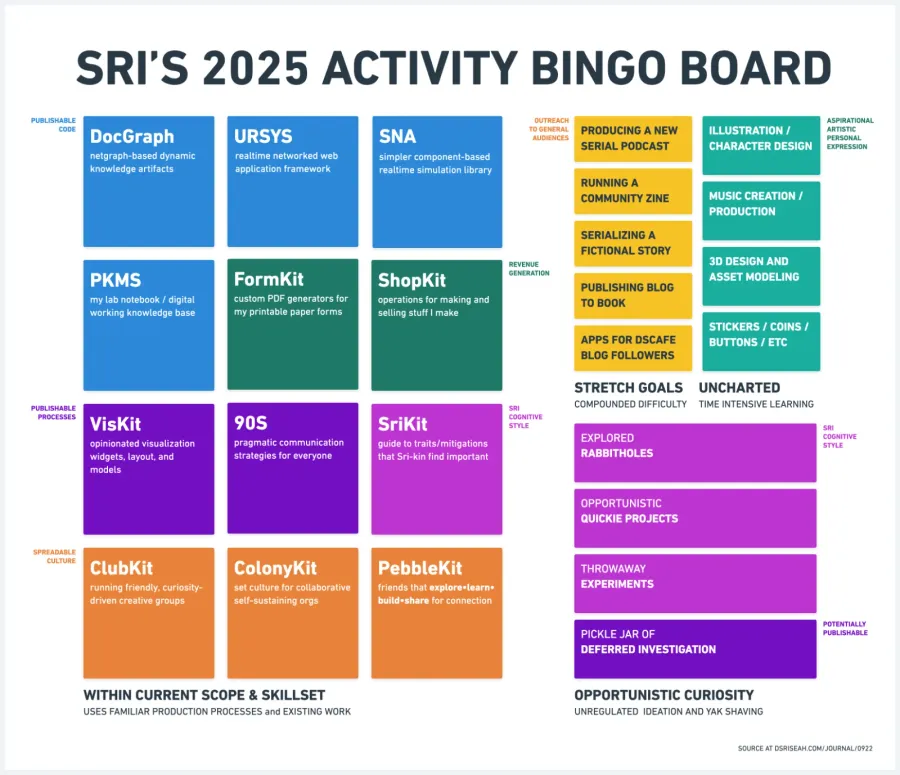
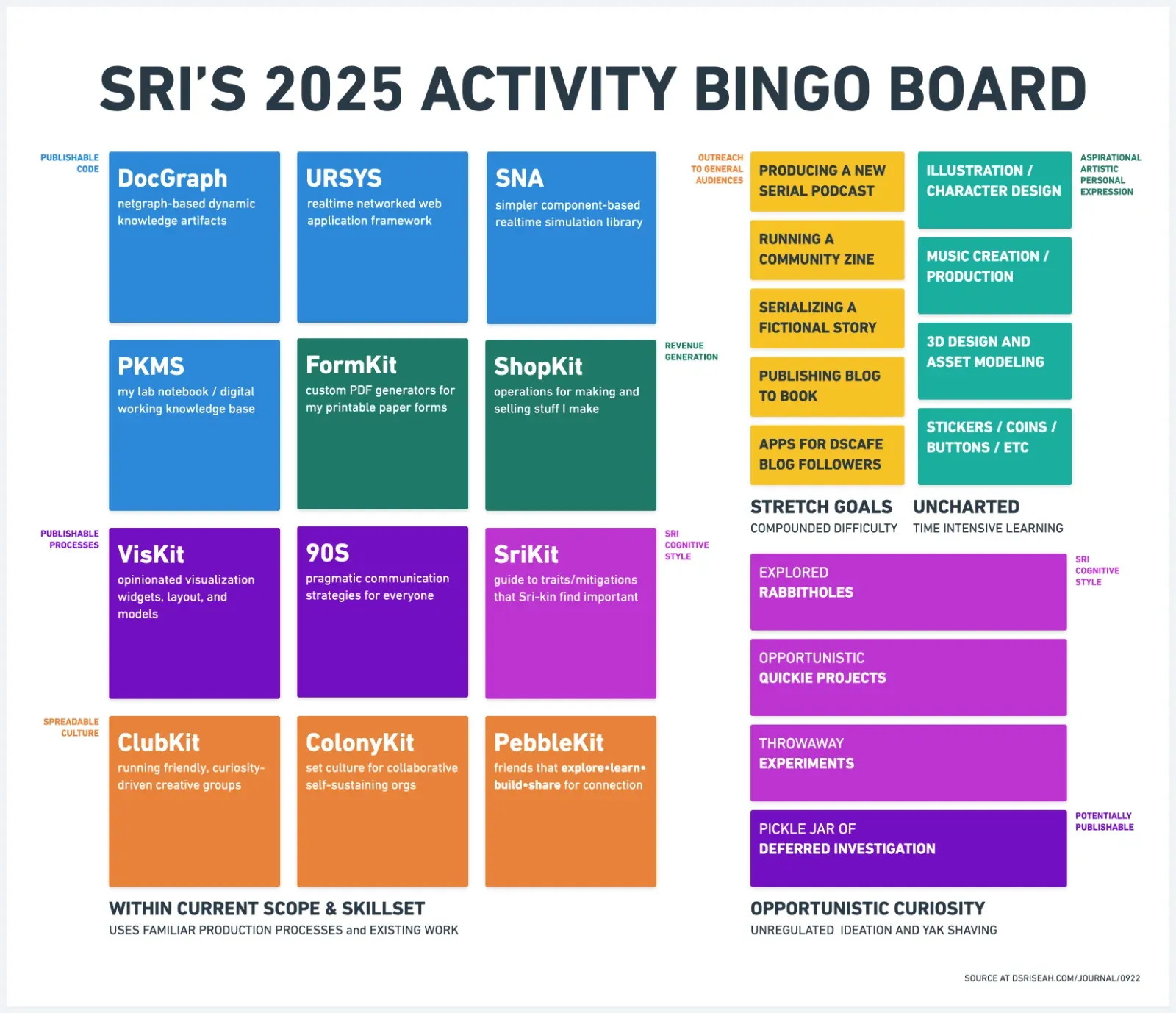
The projects haven’t changed, so I can continue to use the same diagram.
Structure: Use the Two-Slot Aux Capacity Model
This is a scope limiting approach to selecting tasks that I call Two Slots + Aux. The basic idea is that I have limited working memory, and find it difficult to do more than one thing at a time.
- SLOT 1 is the main task of the day
- SLOT 2 is the alternative task of the day
- AUX is for everything else: distractions, unexpected events, chores, etc
This works for uncertain tasks that require lots of experimentation, research, and decision making. This is very tiring. The vast majority of my tasks fall into this category.
While this does not look like much of a process, it does give me permission to accept my cognitive limits in the face of uncertain tasks.
Process: Use Blogging Challenges to Power Creative Conversation
I love talking about what I’m making, but as I’m currently lacking creative peers the next best thing is writing about it. By sharing the results of my work frequently, I can derive a feeling of satisfaction while also inviting people to follow along. Sometimes, people even reach out and we chat, which is what I want.
The challenge format is a themed blogging format where I write daily about what I’m making. The Month of Building was the last challenge I did, producing many blog posts documenting useful work I did to advance my projects.
I’d like to use a looser version of this format that doesn’t have the daily posting requirement, as it’s quite demanding. It provides a sense of purpose and flexible structure that works nicely with Two-Slot Aux.
Process: Use Gathering-Style Productivity
Most productivity systems emphasize (1) setting a goal (2) breaking the goal into steps (3) following the steps (4) deliver results (5) repeat until goal is met. It makes perfect logical sense. It also doesn’t work with ADHD and completely ignores the emotional regulation / executive function needs.
Gathering-style productivity is different, focusing on collecting what was done in a day instead of running a production line. It’s analogous to having a fruit farm with many plants producing different fruit that ripen at different times. By maintaining the fruit farm, you can collect the ripe fruits and clean them up for putting into your fruit stand!
This does require discipline to do the collection frequently enough as well as interest in running a cool fruit stand. I love the analogy myself so it works for me. My fruit stands are this website and my dormant Shopify store.
So this is what I’m starting with for 2026! To recap everything in one place:
GHDR 2026 in a Nutshell
Questions
- How can I be myself without pushing people away?
- Am I just not intrinsically motivated? Are my aspirations beyond my grasp?
- Do I actually like doing anything at all? Am I just coping with social isolation?
Directives
- Continue to practice “Values-First” productivity principles.
- Release what I Blog, Design, and Code into the Universe.
- Let go of old patterns based on past trauma. They no longer apply.
- Don’t worry about planning. I can be tactical/strategic/emotional when the moment calls for it.
- Don’t focus on end game strategic results. Focus instead on the joy of now.
- Seek outlets for expressing my flavor of authenticity, transparency, and curiosity. Small ways are fine!
- Separate “community” from “collaboration”. These are two different concerns that serve different needs.
- Seek a small circle of creative friends. Larger communities serve a different purpose.
Structure and Process
- Use the Activity Bingo Board for Focus
- Use the Two-Slot Aux Capacity Model
- Use blogging challenges to power creative conversation
- Use Gathering-Style Productivity
Metric: Performance Indicators
- I am making money by selling my own products made to my specifications
- I have found one new person who becomes part of my “circle”
- I feel happy and connected to people, independent of working partnerships
Metric: Improved Well-being
- Less planning because I can trust in my abilities!
- Less worrying, because it usually doesn’t help!
- Better executive and emotional moderation!
Next Steps
On the production side:
- Define some blogging challenges and schedule them!
- Set up a minimal tracking system using Two-Slot+Aux
- Set up a system for the Gathering-Style productivity fruit stands
- Sell some stuff online!!!
On the Emotional/Executive Regulation Side:
- Maybe set up a journal somewhere. It could be part of the minimal tracking system for Two-Slot Aux
- Be whimsical and secure in process. No need to worry. Experiment and share with friends who are in my circle.
- Exude cheerfulness while being authentic, transparent, and curious! Share selectively online!
On the Circle/Community/Letting Go Side:
- Schedule social interactions
- Reach out to Friends
- Offer to help people, request help from people
- Find small ways to share with people
That’s it for now! Wish me luck!
INDEX of GHDR 2026 POSTS
Kickoff Pt 1: A brief overview of the “four acts” of 2025
Kickoff Pt 2: Identifying the big questions to explore in 2026
Kickoff Pt 3: The Plan
Blunting Fear and Anxiety
Apr 4
…
May 5
…
Jun 6
…
Jul 7
…
Aug 8
…
Sep 9
…
Oct 10
…
Nov 11
…
Dec 12
…
Groundhog Day Resolutions 2026 Kickoff Part II: Big Questions
GHDR Report 03/03: Blunting Fear and Anxiety
Chat about tools and aspirational projects on my DS|CAFE Discord server
Chat me up on Mastodon and Bluesky